Fidget Toys for Focus: An Honest Take on What Actually Works
If you've ever bought a fidget to help you focus and found yourself clicking it instead of working for an hour, this guide is for you. Some formats help, some don't, and some make focus worse. Here's how to tell the difference.
What "Focus" Actually Means Here
Focus is a layered thing. There's deep focus, the kind where you lose an hour to a hard problem and come out with a solution. There's sustained focus, where you push through a long task without drifting. There's also the kind of focus that survives a 30-minute meeting without checking your phone. A fidget toy helps differently with each kind, and the format you pick should match the kind of focus you're trying to support.
This guide doesn't make medical claims. Fidgets aren't a treatment for any condition. The effects described here are observations from people who use them — not a substitute for what a clinician would say if you have a diagnosed attention condition. The word "focus" in this guide means what most adults mean by it: staying on one task long enough to finish it.
Why Some Fidgets Help and Others Don't
A fidget helps focus when it gives your hands a quiet repeatable task that doesn't pull your eyes or thinking away from the work. It hurts when the fidget becomes the work — the click is more interesting than the task, or the fidget requires enough attention to compete. Three properties separate helpful from unhelpful. Low visual cost: a fidget that moves in your peripheral vision pulls your eyes — a magnetic slider stays still when not in use, a haptic coin stays still always, a spinner in motion is hard to ignore. Low cognitive cost: a fidget that requires thought takes attention from the task — a magnetic slider is one-thumb (push, release), a haptic coin is shift and roll, a trackless slider balanced on edge is a skill task not a focus aid. Low reward escalation: some fidgets escalate (you try to make the click louder, the spin longer) and that competes with the task. Pick fixed reward (a click is a click) over variable reward (this spin might be 30s, this one 90s).
Best Formats for Focus, Ranked
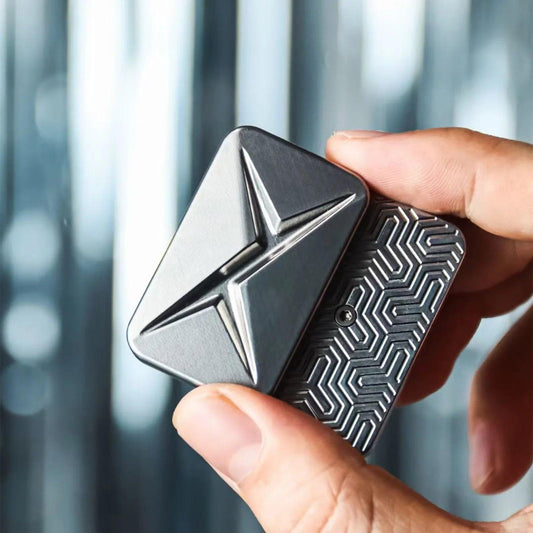
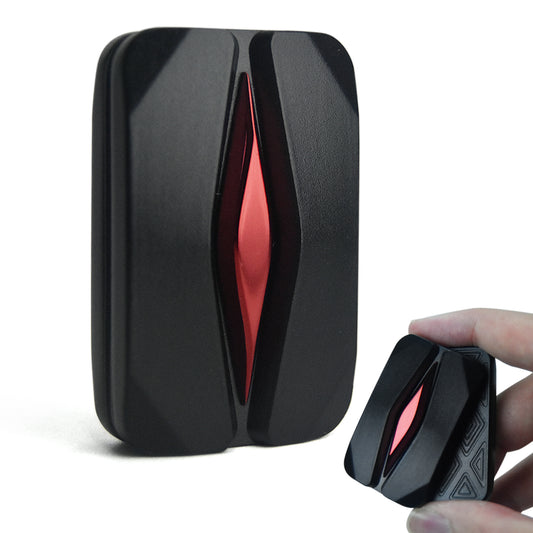
Four formats work; each helps a different kind of focus. Haptic coins are the strongest focus fidget — sits in the hand or on the desk, internal weight shifts with gravity as you move your fingers, no click no sound no motion that pulls your eyes; the fidget is the small ongoing shift of the weight; silent in use and almost no attention to operate. Most adults who try one for focus keep it on the desk next to the keyboard. (The haptic coin guide explains the format.) Magnetic sliders are the close second — one-thumb, push and release with a clean click, motion repeatable and short, sound disappears in an office; work well in calls, writing, long reading. Catch: the click is a small reward and some adults click faster; if that happens, drop the slider to the desk. Metal spinners can work but are higher-risk — a spinner in motion is visually interesting to you and to anyone nearby; keep it slow and short (10-second spin, then put it down); don't use for a long reading or writing task. Trackless sliders are the worst focus fidget — reward tricks (balance, free spin) that pull attention; better as a five-minute break. The ranking is consistent: quieter and less visual = better for focus.
When a Fidget Helps vs. When It Doesn't
Three situations where a fidget reliably helps. Long, low-stimulation tasks (reading, writing, long email threads — fidget gives the hands something to do so the brain doesn't drift). Calls and meetings (a quiet fidget is a safer outlet than tapping a pen or checking a phone; most adults who carry one to calls report they listen better with something in their hand). Stress transitions (ten seconds of clicking a slider can be a better reset than a phone scroll after a hard meeting or email).
Three situations where it doesn't help, and may hurt. Tasks that need deep reading or complex writing (if the task already pulls your full attention, a fidget is one more thing; skip it). Tasks that are already too stimulating (a loud office, a chaotic day, a deadline that has you wired — a fidget won't fix the underlying stress, just give your hands a job while your brain stays tense). When you're using the fidget as a procrastination tool (if the click becomes the goal, you've replaced the task with the fidget; notice the switch and put it down). The honest line: a fidget is a support for focus, not a fix. It works when the task is reasonable and the environment is sane.
A Quick Note on Safety
A focus fidget is an adult object — small parts and strong magnets are not for children. Keep fidgets away from young children; don't store magnetic fidgets in the same pocket as credit cards, hotel keys, or magnetic phone cases. The fidget is a focus aid for grown-ups, not a substitute for sleep, exercise, or a real conversation with a clinician if focus is a real problem. The EDC fidget toys explained guide covers the carry-and-reach habit in more detail.
FAQ
Do fidget toys actually help with focus?
For some adults, yes — a quiet repeatable motion gives the brain a low-effort task and can help sustain attention on tasks that don't fully engage it. Individual; not a treatment for any condition.
What's the best fidget for focus and concentration?
Haptic coin first, magnetic slider second. Both quiet, low-visual, no escalation. A spinner can work for short tasks but is harder to ignore visually. A trackless slider is the worst focus fidget.
Can a fidget help with ADHD or anxiety?
Not a treatment. Some adults with these conditions find a fidget helps with restlessness, but the right answer for a diagnosed condition is a clinician, not a toy. Use fidgets as a complement to good habits and any treatment you're already using.
Is a fidget good for studying?
For reading and writing, yes. For deep mathematical or analytical work, the fidget is more likely to compete with the task; skip it.
Find a Fidget That Fits Your Focus
The best-sellers shelf covers the focus-friendly formats. For the quietest option, the haptic coin guide has the format; for a click-and-go, the poker-card slider collection is the most common first pick.