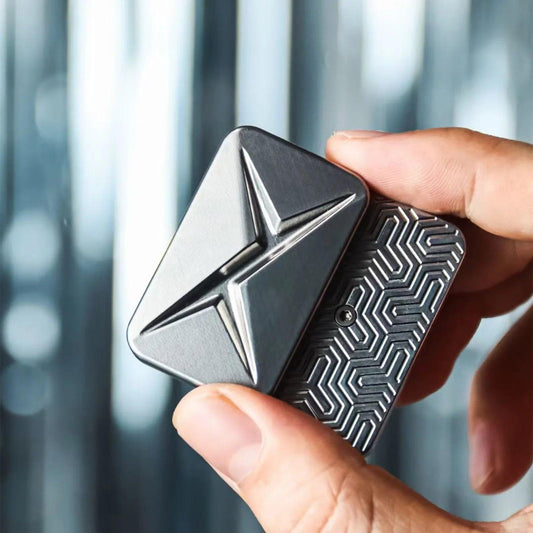
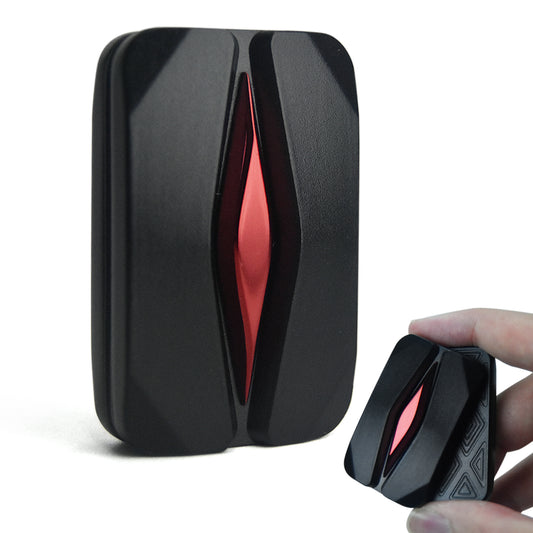
Magnetic vs Mechanical Fidget Sliders: The Real Differences
If you've been looking at fidget sliders and seen terms like "magnetic," "mechanical," and "ding" thrown around without explanation, this guide is for you. The two common formats look similar in photos but feel and sound nothing alike. Here's the real difference and which to pick.
What "Magnetic" and "Mechanical" Actually Mean
Both formats have a frame and an inner piece that slides. The difference is the return mechanism — the part that pulls the inner piece back home after you push it out.
A magnetic slider uses small neodymium magnets to pull the inner piece home. Push out, release, the magnets do the rest. The click at the end of the slide is the magnets snapping into alignment, with a small contribution from a mechanical stop. The magnetic sliders guide has the full breakdown of how the mechanism works.
A mechanical slider uses a spring, detent, or fixed track instead of magnets. The classic example is the "ding" slider, where the inner piece slides and lands with a metallic *ding*. The return is mechanical, and the sound comes from the metal-on-metal contact of the inner piece meeting the stop. The dingding collection at KOMO EDC is the mechanical "ding" style.
Both are valid formats. They're just built around different mechanisms that give different feels. Most adults who try both end up preferring one or the other within a week of daily carry.
How They Feel in Use
The feel is where the two differ most, and it's the difference that decides which you'll keep. A magnetic slider feels alive — the further you push out, the harder the magnets pull back; resistance is variable (light at first, heavy toward the end, clean snap home); soft start, decisive finish; same click every time, no escalation. A mechanical slider feels deliberate — the spring or detent is fixed so resistance is even throughout; the motion is a single predictable travel; the landing is louder and sharper ("click-clack"); the sound escalates slightly with how hard you push, which some like and some don't. A magnetic feels almost organic, like the slider is reacting to your hand. A mechanical feels engineered, like the slider is doing the same thing every time and your hand is the variable. If you've only tried one, you've only tried half the category.
Sound: Click vs Ding
Both formats are audible but the sound character differs. A magnetic click is medium-loud and short — you hear it across a quiet desk, next to you in a meeting, and it disappears in a noisy office; the click is the same every time because the magnets are deterministic. A mechanical ding is louder and sharper — the ding resonates for a fraction longer and sounds more bell-like; a heavy push gives a louder ding, a gentle push a quieter one; the sound is variable, which some find more interesting and some find harder to ignore. If sound matters (and it does in offices, libraries, video calls), magnetic is the quieter format; mechanical is the more expressive one. Pick magnetic for predictable sound; pick mechanical for sound that varies with how you use it.
Weight and Pocket Feel
Both formats land in the 50-100 g range for a pocketable slider. Magnetic is usually a touch lighter for the same size frame (magnets are small, the rest is just frame and inner piece) — a 70 g magnetic feels light and quick. Mechanical is often a touch heavier because the spring or detent adds mass and the inner piece is built sturdier to handle repeated mechanical impact — a 90 g mechanical feels solid and substantial, the way a heavier object does. Both are pocket-friendly. In a fifth pocket all day the difference is real but not dramatic; in a small EDC pouch next to other items, the weight difference is the difference between "you notice it" and "you don't."
Which Format to Pick
Match the format to your situation. Pick magnetic if you're at a desk, office, or on video calls and want predictable sound; want one-handed operation that disappears into the background; want repeatable consistent feel for daily carry; or you're new to fidget sliders and want the safe default. Pick mechanical if you want a louder, more expressive sound with personality; you like the fixed deliberate motion of a spring-loaded mechanism; you want the ding to be a feature not a bug; or you're okay with the sound escalating slightly with how you push. If you've never tried either, start with magnetic — the most common first pick and the safest format for office and home. Add a mechanical ding slider as a second carry once you know you like the category.
A Quick Note on Safety
Both formats use small metal parts. Keep either format away from young children — magnets are a hazard if swallowed in pairs, small parts are a choking hazard. Don't store a magnetic slider in the same pocket as credit cards, hotel key cards, or magnetic phone cases. The slider is a desk object for grown-ups.
FAQ
What is the difference between magnetic and mechanical fidget sliders?
The return mechanism. A magnetic slider uses neodymium magnets to pull the inner piece back home. A mechanical slider uses a spring, detent, or fixed track. The feel, sound, and weight differ as a result.
Are magnetic or mechanical fidget sliders better?
Neither is objectively better. Magnetic is the safe default for office and home (predictable sound, one-handed, repeatable). Mechanical is louder and more expressive (the ding is a feature, not a bug). Pick the format that matches your use case.
Are magnetic sliders louder than mechanical?
No — magnetic is quieter. The click is medium-loud and short; the mechanical ding is louder and sharper. In an office, the magnetic slider disappears faster.
Do mechanical sliders wear out faster?
Cheap ones do. A high-quality mechanical is built for tens of thousands of cycles (years of normal use). The spring is the wear part; magnets in a magnetic slider are essentially immortal for everyday use.
Find the Format That Fits
The best-sellers shelf shows both formats side by side. For magnetic, the poker-card slider collection; for mechanical, the dingding collection. The Gold Ace is the most popular mid-range magnetic build.