Why Visual Spinners Fail in Real EDC
You already know the scene. Someone across the table pulls out a metal fidget spinner, flicks it, and the whole room watches it go. For thirty seconds, the spinner is the loudest thing in the room that isn't a conversation. That's the core reason why visual fidget spinners fail as adult everyday carry: the format is built around being seen, and the places you actually need a fidget are the places you cannot afford to be seen doing it.
The Short Version
Spinners are visual-first. Office, travel, video calls, and shared desks are audio-and-camera-first. The mismatch is the whole story. If you want a fidget you can use without anyone noticing, you want something that lives in your hand and resolves into a sound or a click, not something that resolves into a blur.
What "Visual" Actually Means in a Spinner
A spinner is a bearing-driven rotor. Its job is to turn fast enough to look like a disc, then coast. The fidget is the watching — yours and everyone else's. A metal fidget spinner with a quality bearing will run two to four minutes, which sounds like a feature until you realize what it costs in attention. Two minutes of visual input is two minutes of eyes off your screen, off your meeting, off the person talking to you.
The format is honest about what it is. A fidget spinner is a display piece with a side effect. Carry one if you want a display piece. Don't carry one expecting focus help — the visual loop is what the body is doing, and it's hard to read an email while watching a rotor blur.
Why Visual Fidget Spinners Fail at the Office
The office has a noise floor of about 40 to 50 dB. A spinner adds a bearing hum on top of that — small, but pitched in a range that carries across a quiet room. Co-workers at the next desk hear it. Worse, the visual pull is stronger than the audio pull: the second the rotor starts, eyes move. In a meeting, that's a problem. In an open-plan row of desks, that's a worse problem.
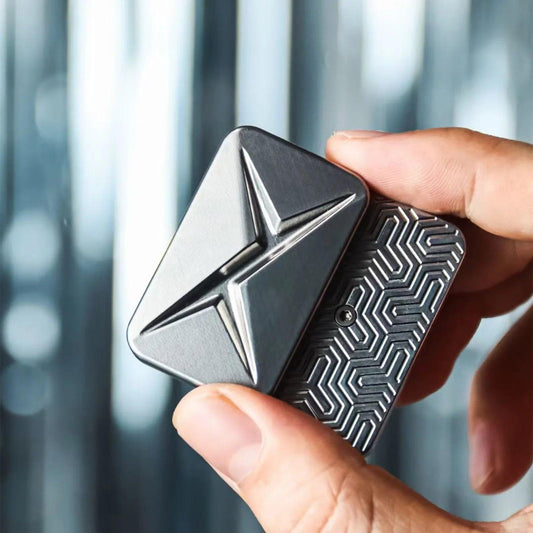
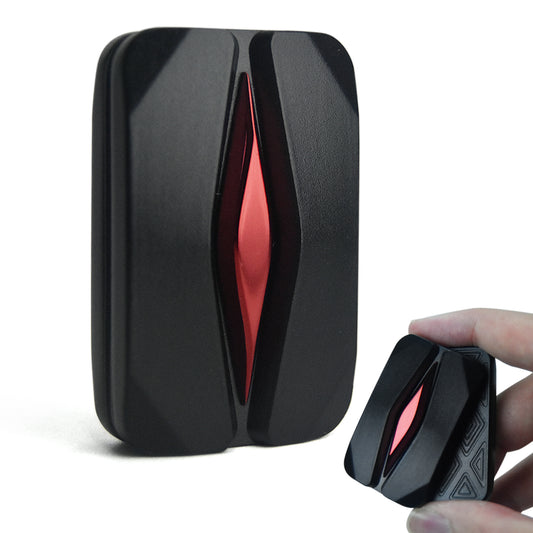
Compare that to the poker-card magnetic sliders in the KOMO EDC lineup. The slider gives you one audible click per stroke, your hand stays below desk line, and the motion reads as "person fidgeting with a card" rather than "person spinning a UFO." Same restless-hands use case, completely different social signature. That's why visual fidget spinners fail at desks: they trade a small private habit for a large public event.
The Travel Friction Nobody Talks About
On a plane, a spinner is worse than useless. A single bump of turbulence makes the bearing skip, the rotor wobbles, and the part that was supposed to be smooth becomes a juddering thing you now have to stabilize with your other hand. In a seat-back tray with a laptop, you don't have another hand. The format was designed for a stable palm on a stable surface, and travel is the opposite of that.
Sliders — including the magnetic Gold Ace at 71 g and 1.77 by 1.34 by 0.39 inches — behave better in turbulence because the moving part is captured. The neodymium magnet holds the inner plate inside the body even when the plane drops. Your hand does the same motion it would at a desk. Travel is one of the clearest reasons why visual fidget spinners fail for adult EDC: the format is physically optimized for stillness, and travel is physically optimized for not-still.
Video Calls and the Camera Problem
On a video call, anything in your hand is on camera. A rotor in motion is a strobe effect that pulls the viewer's eye away from your face. Camera compression makes it worse — the blur turns into a flickering block that video codecs handle badly. The visual format that looked great in person looks broken on a 1080p webcam.
A trackless slider like the Mountain has the opposite property. Below the desk line, the camera sees your hands resting. The trick motion — if you do one at all — happens between thumb and finger and reads as nothing. For calls, the rule is simple: nothing in your hand should move fast enough to outrun the camera's frame rate. Spinners outrun it constantly.
The Quiet-Fidget Alternatives That Actually Work
If the use case is adult everyday carry — office, commute, plane, call, focus block — the formats that earn their space are the ones that resolve into sound or feel, not sight.
- Magnetic slider (Gold Ace, King of Hearts): one audible click per stroke, 71 g, captured mechanism. The default office and travel pick.
- Mechanical "ding" slider: a softer, lower-pitched click for people who want something audibly different from the magnetic click.
- 2-in-1 format: silent rotation plus magnetic slide in one body, for users who actually want both modes.
- Haptic coin: completely silent, no visual signature at all. The most office-proof option in the broader category.
JUDIXY on Amazon also carries metal sliders in the same format range, useful for side-by-side comparison if you want to weigh weight and feel across brands before buying.
When a Spinner Is Still the Right Call
Spinners aren't bad. They're mismatched. If your fidget use case is a home desk, a workshop, or a private room where you want a 2 to 4 minute visual reset between tasks, a metal spinner does that job and looks good doing it. The Open Armor body is stainless, the bearing is mid-grade, and on a stable surface it runs long enough to count as a real break. Just don't expect that same spinner to behave on a plane or in a meeting — those are different environments, and the format doesn't adapt.
FAQ
Are fidget spinners bad for focus at work?
They aren't bad in a moral sense, but the visual loop pulls your eyes off the screen and the bearing hum adds to the office noise floor. A magnetic slider gives your hands the same outlet with one click per stroke and no visual signature.
What is the quietest fidget format for an office?
A haptic coin is silent. A magnetic slider is the next quietest, with a single audible click per stroke. Both stay below desk line and read as nothing to a co-worker.
Can you use a fidget spinner on a plane?
You can, but turbulence makes the rotor wobble and forces you to stabilize it with a second hand. Magnetic sliders handle turbulence better because the inner part is captured.
Are fidget spinners only for kids?
No, but the spinner format is visual-first and the adult EDC use cases — office, travel, calls — are audio-first and camera-first. That's the mismatch that makes the format harder to carry as an adult. The products contain strong neodymium magnets and small parts. Keep away from young children.
What should I buy instead of a spinner for everyday carry?
The Gold Ace poker-card magnetic slider is the right default. Browse the full Featured Metal Fidget Toys collection if you want to compare formats side by side.