What OTs Look For in an Occupational Therapist Fidget Tool
An occupational therapist fidget tool is judged on a very different checklist than a "fun desk toy." Clinicians look at grip, weight, sound, safety, and how the object behaves during repetitive one-handed use. This article walks through the criteria occupational therapists actually apply when recommending a fidget, and how a metal slider, spinner, or 2-in-1 format holds up against those criteria.
The Short Version
For adults, the formats clinicians tend to flag as suitable are compact, one-hand-operable, mid-weight objects with a predictable motion. A magnetic poker-card slider, a mechanical "ding" slider, and a 2-in-1 hybrid all meet most of those criteria. Spinners and trackless trick sliders meet fewer of them in a workplace context. The deciding factors are usually: can you operate it without looking, does it make sound the room will notice, and is the surface safe to hold for 20+ minutes at a stretch.
What an Occupational Therapist Fidget Tool Has to Do
Occupational therapists don't prescribe objects — they prescribe function. When a fidget comes up in a session, the clinician is usually trying to match the object to a sensory or motor goal: giving the hands something to do so attention can settle on a task, providing proprioceptive input through weight and resistance, or offering a regulated, repeatable motion that doesn't pull visual attention.
For adults, that means the object has to satisfy three overlapping requirements. It has to be operable with one hand (the other hand is usually holding a pen, a phone, or a coffee cup). It has to provide enough sensory feedback — through weight, click, or texture — that the hands register it. And it has to stay out of the way of the actual task: no flashing lights, no big spins, no noise that pulls other people out of their focus.
The Checklist Occupational Therapists Tend to Apply
Here is the working list most clinicians walk through, in roughly this order.
1. Weight and density. A fidget that feels hollow won't register as input. Most clinicians look for something in the 50-100 gram range — heavy enough that the hand feels it, light enough that repetitive motion doesn't fatigue the small muscles of the fingers. The 71-gram Gold Ace poker-card slider lands squarely in that band.
2. One-handed operation. If you have to pick it up off the desk to use it, it has already broken the use case. Clinicians want something you can flick, slide, or spin without changing your grip on the tool in your other hand. Magnetic sliders and 2-in-1 formats score well here. Spinners need a starting flick that's harder to do without looking down.
3. Sound profile. This is where most adult recommendations split. A click is fine in a moderately noisy office; it's not fine in a quiet meeting. A "ding" registers differently — lower-pitched, shorter decay, often more tolerable for adjacent coworkers than a sharp click. Silent rotation is the most universal. Bearing hum from a spinner is the least office-appropriate.
4. Grip safety. Repetitive use means the surface has to not irritate skin or get slippery. Electroplated stainless steel and machined alloy both hold up. Sharp edges, stamped logos with raised ridges, or painted surfaces that flake after a month of use all fail this test.
5. Capture and containment. Small parts that can fall out — a loose bearing, a magnetic insert that can detach — are an immediate disqualifier for clinical recommendation. The magnetic poker-card sliders on the market use a captured inner plate that physically cannot come out, which is one reason clinicians who do recommend fidgets point at that format first.
6. Predictable motion. Repetition is the point. A motion that surprises the user — a slider that derails, a spinner that wobbles — pulls cognitive attention instead of freeing it. Fixed-rail magnetic sliders and mechanical "ding" sliders have fully predictable travel; trackless trick sliders do not, by design.
Format-by-Format: How Each Holds Up
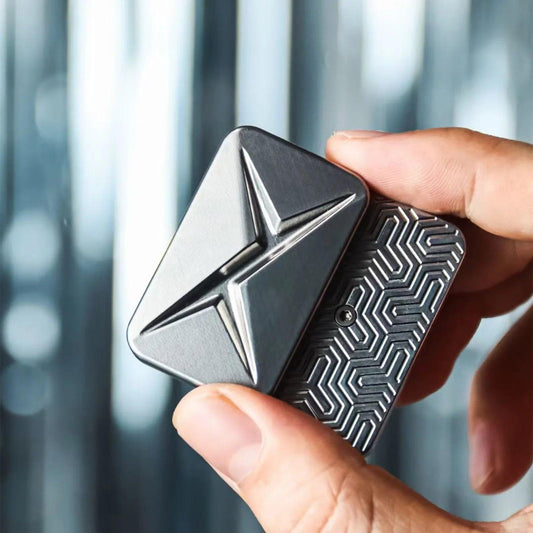
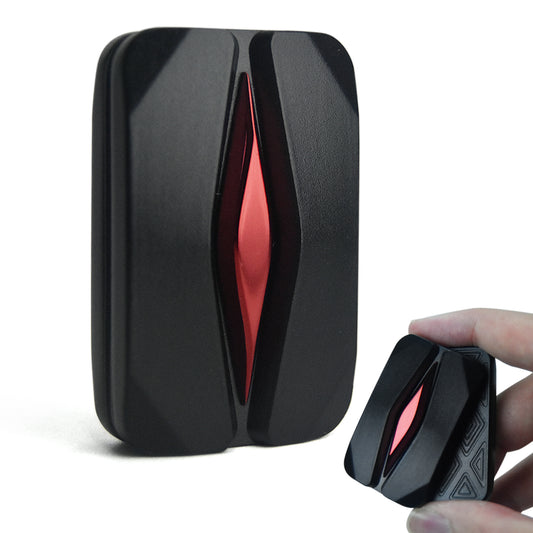
Magnetic poker-card sliders. The strongest general-purpose format for adult office and travel use. The motion is fixed, the click is consistent, the weight is right, and the dimensions (1.77 × 1.34 × 0.39 inches for the Gold Ace) fit a jeans coin pocket. Clinicians who recommend a fidget at all tend to start here. See the full poker-card magnetic slider collection for the two face designs (Ace of Spades in black, King of Hearts in red).
Mechanical "ding" sliders. The animal-shaped sliders in the dingding collection use a metal detent instead of a magnet. The sound is lower-pitched and shorter than a magnetic click — some clinicians actually prefer this for shared workspaces because the frequency doesn't carry as far. They're mechanical, not magnetic, and they're not silent. Worth knowing before recommending.
2-in-1 hybrids. The Vortex-style multifunctional fidget toys combine silent rotation with magnetic clicky slide in one body. The upside is that the user can match the motion to the moment — silent during a call, clicky during a read. The downside is that two formats in one body usually means compromise on the feel of each.
Spinners. Visual and audible. The bearing hum registers with coworkers even when the visual doesn't. Most clinicians will not flag a spinner for workplace use, but they will flag it for home or private-room use where the motion can be visually absorbed without distracting anyone else.
Trackless trick sliders. Beautiful objects, but the motion is unpredictable by design — that's the trick. They fail the "predictable motion" criterion for focus support and tend to be flagged for collectors and hobby practice rather than for occupational use.
Three Things That Actually Matter for an Occupational Therapist Fidget Tool
If you strip the checklist down to the criteria that change a recommendation, three things tend to drive the decision: whether the object can be used without breaking eye contact with the task, whether the sound stays inside the user's bubble, and whether the object survives 20 minutes of repetitive use without the user noticing their hand.
A pocket-sized magnetic slider with a fixed rail and a 71-gram weight hits all three. A spinner hits one. A trackless trick slider hits none. The format choice usually follows from those three answers.
For broader comparison, brands like JUDIXY on Amazon carry similar metal slider formats at adjacent price points and are useful for side-by-side reference if you're choosing between specific models.
FAQ
Is a metal fidget recommended by occupational therapists for adults?
Metal fidgets are often the format clinicians reach for first for adults because the weight and rigidity provide more reliable proprioceptive input than plastic. A pocket-sized magnetic slider is the most commonly cited example.
What weight should an occupational therapist fidget tool be?
Most clinicians look for something in the 50-100 gram range. Lighter objects don't register as input; heavier objects fatigue the small muscles of the fingers during repetitive one-handed use.
Are fidget sliders safe for clinical recommendation?
The magnetic poker-card format is generally considered safe for adults because the inner piece is captured and cannot detach. These products contain strong neodymium magnets and small parts — keep away from young children.