Trackless vs Magnetic Slider: Which One's Right for You?
Choosing between a trackless vs magnetic slider comes down to how and where you actually fidget. The two formats look similar in the hand, but they behave very differently in a pocket, on a desk, and during a long flight. This guide breaks down the mechanics, the sound, the feel, and the use cases so you can pick the right metal EDC fidget without buying both to find out.
The Short Version
Trackless sliders are silent and made for two-handed tricks. Magnetic sliders click on a fixed rail and work one-handed at a desk. If you fidget at work or while traveling, the magnetic slider is the safer pick. If you fidget at home, practice tricks, and want the inner piece to slide freely through captured neodymium magnets, the trackless format is the better tool. Most adults end up wanting both.
Trackless vs Magnetic Slider: What's Actually Different
The two formats use the same core ingredient, neodymium magnets, but solve different problems.
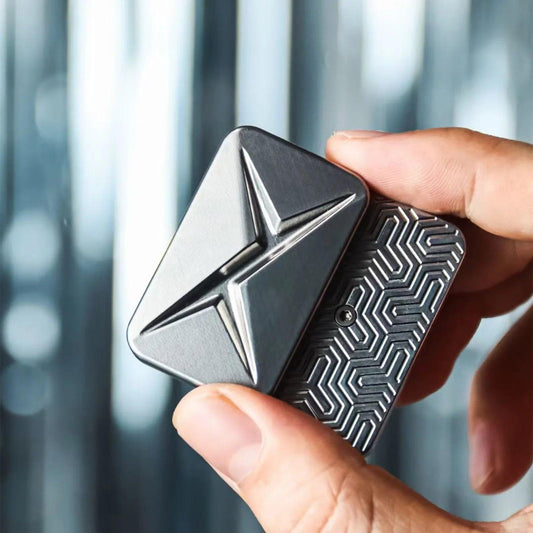
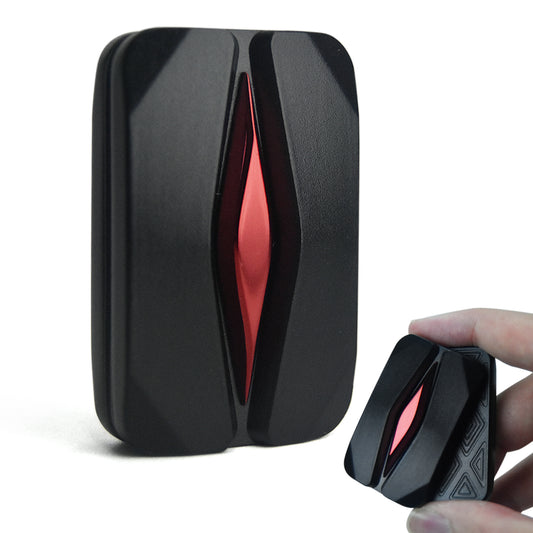
A magnetic slider like the Gold Ace poker slider has a fixed internal rail. The captured inner plate rides that rail and stops at each end with an audible click. The motion is predictable, repeatable, and works one-handed with your thumb. Body material is electroplated stainless steel, weight is 71 g, and dimensions come in at 1.77 × 1.34 × 0.39 inches.
A trackless slider like the Mountain drops the rail. The inner piece is still captured by magnets, but it floats freely inside the housing. That freedom is what enables tricks: flips, mid-air catches, and controlled slides through the magnetic field. The trade-off is that the format is two-handed by design and silent in motion.
The decision in the trackless vs magnetic slider debate is really a decision about whether you want a one-handed clicker or a two-handed trick tool.
Sound and Stealth
Sound is where the two formats diverge the most.
The magnetic slider produces a clean click at each end of travel. That click is loud enough to be heard by a coworker one desk over in a quiet office, but soft enough to disappear under typing, music, or a coffee shop hum. It is not silent, and it is not loud.
The trackless slider produces almost no sound. The inner piece moves on magnetic resistance alone. There is no click, no detent, no ding. If you need absolute silence for a video call, an open-plan floor, or a shared workspace, trackless wins. If you want the satisfying click as feedback that the motion completed, magnetic wins.
For bedrooms, libraries, and very quiet rooms, neither is perfect: the magnetic slider's click can wake a sleeping partner, and the trackless slider's silent motion has a visual giveaway if anyone is watching your hands.
Pocket Feel and Everyday Carry
Both formats are pocket-friendly, but they carry differently.
A 71 g magnetic slider in a poker-card shape slides into a front pocket next to a wallet and barely registers. The flat 0.39-inch profile keeps it from printing, and the smooth edges do not catch on fabric. For travel, the magnetic capture means the inner piece stays put even during turbulence on a flight or in a rideshare.
A trackless slider is heavier in the hand and often slightly thicker because the housing has to leave room for the inner piece to travel. It carries fine, but it does not vanish into a pocket the way a flat poker slider does. Turbulence is also a real problem: the free-floating inner piece will slide on its own during a hard bump, and the result is a small metal thud against the housing.
If everyday carry is the main use case, the magnetic slider is the easier format to live with.
Tricks, Visual Fidgeting, and Display
This is where the trackless format earns its existence.
Without a fixed rail, the inner piece can leave the housing briefly under controlled motion. That is what makes mid-air flips, catches, and slow drops possible. The Mountain trackless slider is built for this kind of two-handed play. It rewards practice, looks striking on a desk between uses, and does not feel like a one-trick object.
The magnetic slider is not a trick tool. The rail limits the inner piece to a defined path, which is exactly why the format is predictable and repeatable at work. Trying to do flips with a magnetic slider is fighting the design. The poker-card format is meant to be clicked, not flipped.
If you fidget primarily with your eyes and your hands in a private space, the trackless format is the more interesting object. If you fidget during work calls and meetings, the magnetic format is the more useful one.
Where Each Format Fits
A quick way to map format to situation:
- Office, focus work, video calls: magnetic slider
- Travel, flights, commutes: magnetic slider
- Trick practice, two-handed play: trackless slider
- Home desk, display piece: trackless slider
- Collectors who want both formats in the rotation: magnetic + trackless
JUDIXY on Amazon also carries metal sliders in both formats, which is useful if you want to compare the click profile and the weight side by side before committing. Within KOMO EDC, the poker-card magnetic sliders cover the clicker side and the trackless slider collection covers the trick side.
FAQ
Is a trackless slider louder than a magnetic slider?
No. A trackless slider is essentially silent because the inner piece slides on magnetic resistance with no fixed stop. A magnetic slider clicks audibly at each end of the rail.
Can I use a magnetic slider one-handed?
Yes. The fixed rail and captured inner plate are designed for thumb-driven, one-handed use. That is what makes the format work at a desk.
Can a trackless slider do tricks?
Yes, that is the main reason to buy one. The free-floating inner piece supports controlled flips and catches with two-handed practice. Trick difficulty depends on the user, not the slider.
Which format is better for travel?
The magnetic slider. The captured inner plate does not shift during turbulence. A trackless slider's free-floating piece will move on hard bumps.
Are these safe to carry around other people?
Both formats use strong neodymium magnets and small parts. Keep away from young children, and keep them at least a few inches away from credit cards, hotel key cards, and personal electronics with magnetic storage.
Pick One and Carry It
If you only buy one slider, the magnetic format is the safer default for most adults. The click is satisfying, the pocket feel is right, and it works one-handed during the parts of the day when your hands actually need something to do. If you already have a desk fidget and want something more involved for evenings and weekends, add a trackless slider to the rotation. The two formats do not compete so much as cover different parts of the week.
Start with the magnetic poker-card slider collection if you want a clicker, or browse the full KOMO EDC shelf if you want to see every metal fidget format side by side.