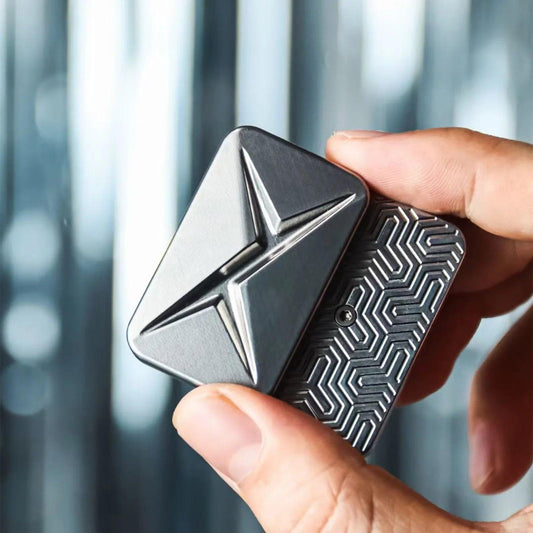
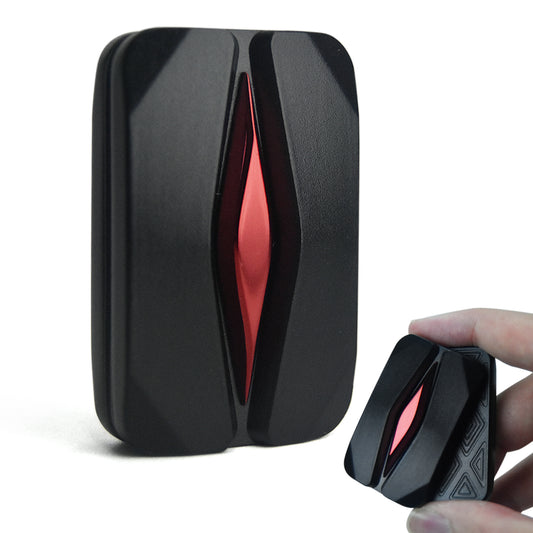
Magnetic Fidget Credit Card Safety: Will It Wipe Your Hotel Key?
You just spent real money on a metal magnetic fidget credit card slider. It weighs about 71 grams, sits in your pocket next to your wallet, and now you're reading forum threads about whether it's going to wipe your credit cards or your hotel key. Fair question. You've spent real money on both the toy and the cards in your wallet, and nobody wants to discover the answer at the front desk of a Hilton at 11 p.m.
The reassuring news: the actual risk to most cards is lower than Reddit threads suggest. The honest answer requires digging into three things — what kind of magnet is inside the fidget, what kind of strip lives inside your cards, and how close things actually sit in a normal pocket. None of those are complicated on their own. Together they explain why some people report problems and others carry the same fidget for years without one.
What Kind of Magnet Is Inside a Magnetic Fidget Credit Card?
Poker-card style sliders are magnetic fidget credit card format toys built around a small neodymium magnet. Neodymium is the strong kind — the kind that snaps to a fridge with a satisfying clack. But the magnet inside a slider is sized for the job it has to do: pull a captured steel inner plate back to its stop. That's a fraction of an inch of throw at a fraction of an ounce of pulling force.
Compare that to the magnets that actually damage magnetic strips: the ones in MRI machines, large speaker cabinets, industrial lifting equipment, magnetic name-plate sweepers at airports, and old CRT televisions. Those are orders of magnitude stronger and have meaningfully larger fields that extend several inches or more.
The slider magnet is enclosed in a stainless steel body. Steel attenuates magnetic fields the way walls attenuate sound — it doesn't block them entirely, but it cuts the strength that escapes into open air. So when the slider sits in your front pocket and your wallet sits in the back, the field that reaches the magnetic strip on a credit card is much weaker than the field at the magnet itself.
What Actually Lives Inside Your Credit Card and Hotel Key
This is the side most forum answers skip, and it's the more important one.
Modern credit and debit cards stopped using magnetic stripes as their primary data carrier around the early 2010s. Today most cards are EMV chip plus contactless. The stripe is still there as a fallback for older terminals, but it isn't load-bearing. Even if you somehow nuked the stripe on a card, the chip would still work at every chip reader and the tap-to-pay would still work at every contactless terminal. You'd have a card that swipes poorly in a 1995 gas pump and works everywhere else.
Hotel keys are a different animal. Hotel keycards are typically one of three types: older magstripe (still common in mid-range hotels), RFID proximity cards (common in newer builds and higher-end chains), or smart cards with both. The magstripe hotel keys are the genuinely vulnerable ones. The RFID ones are not magnetic in the relevant sense — they're powered and read by an electromagnetic field at close range, not by storing data as magnetization on a strip. Your slider magnet has effectively zero effect on them.
For the magstripe hotel key, the question becomes: how strong is the field, at what distance, and for how long does it need to be applied to corrupt the strip?
What a Worst-Case Scenario Actually Looks Like
Picture the worst case: a slider with a captured neodymium magnet pressed flat against a magstripe hotel key for a full second or longer. That's the scenario where you'd see real risk. The slider body concentrates the field, the magnet sits right against the plastic, and you're giving the field time to do work.
Real pockets don't work that way. The slider is in one pocket. The wallet is in another, or in a bag, or on a table while the slider is in your hand. There's fabric, distance, and usually movement between them. A sliding inner plate in your pocket is also constantly changing orientation — the magnet doesn't sit still next to one spot on your cards for hours.
What actually wipes hotel keys, in the cases that make it to a front desk: magnets in tablet covers, magnetic clips on phone cases, and the magnets inside the magnetic clasps on some handbags. Those are either larger surfaces held firmly against the card stack for extended periods, or higher-strength magnets you wouldn't think of as magnets. A fidget slider is neither.
How to Carry Both, Comfortably
If you want belt-and-suspenders peace of mind, the answer is boring and cheap: keep the slider in a different pocket from the wallet. Front pocket slider, back pocket wallet. Or jacket pocket for one, jeans pocket for the other. That's enough physical separation to put even the most pessimistic scenario outside the range of damage.
When you travel, the rule is the same: don't store the slider loose in the same compartment as your passport card and your spare hotel key. Hotel room safes are excellent. Bags have multiple pockets for a reason. A small cloth pouch solves it entirely.
One last thing worth knowing: if a hotel key does stop working, it almost always is the key, not your wallet. Front desks replace them free, in about thirty seconds. The reason this matters is that people blame whatever magnet they bought recently. The actual culprit is usually a card that was on its last legs anyway — magstripes wear out from being swiped and carried in a warm back pocket for two years.
FAQ
Can a magnetic fidget credit card erase a chip credit card?
No. Chip cards store data in a microcircuit and aren't affected by static magnetic fields. The magnetic stripe on the back is a fallback for older terminals, and the chip and contactless symbol both keep working even if the stripe were damaged.
Will it wipe the magstripe on a hotel key?
Only under very specific conditions: the magnet held directly against the stripe, in steady contact, for a noticeable duration. Carried in separate pockets or separated by a wallet layer, you're fine. Most reported wipe incidents trace back to magnetic phone or tablet covers, not fidget toys.
Where to Start If You're Buying Your First One
If this is your first metal EDC slider, the magnetic format is the one most adults land on. It's tactile, it satisfies a real compulsion during focus work, and it makes a sound you can hear without making a sound the whole row hears. Browse the full KOMO EDC collection to compare the magnetic, mechanical, and trackless formats side by side — each one behaves differently in a pocket and around your other gear, and the right match depends on what else you already carry.
One caution that applies to all of these: keep away from young children. The magnets and small parts are not safe for kids, and a few minutes of separation goes a long way. Adults only, with the adult answer being: carry it in a different pocket, stop worrying about the wallet.