Fidget Toys for Night Shift: Quiet Enough for a Sleeping House
This guide covers fidget toys night shift in plain terms, with no marketing fluff. If you work nights and someone else in your house is sleeping, the wrong fidget will get you kicked out of the bedroom within an hour. Fidget toys for night shift use need to clear a much higher bar than daytime picks: no clicks, no bearing hum, no thunks. This guide walks through which metal EDC formats stay quiet enough for a shared room, which ones are dealbreakers, and how to test a new toy before you commit.
Why night shift is the hardest test for a fidget toy: What an fidget toys night shift Actually Means
During the day, a medium-volume click is fine. The office tolerates it. A coffee shop drowns it. Your partner is awake, watching TV, half-listening. At 2 a.m., every other person in the house is in stage 3 sleep, and the only ambient noise is the refrigerator and maybe rain. In that hush, a magnetic slider that seemed "not loud" at your desk is now a sound grenade.
The quietest fidget toys for night shift workers all share one trait: they don't have hard detents. The mechanical part that makes a satisfying click on a magnetic slider is the same part that wakes people up. When you're shopping for late-night use, you're basically shopping against the click.
Format-by-format: what stays quiet and what ruins your night
Not every fidget format fails the bedroom test. Some are silent by design. Others can be tolerated with caveats. A few should never come near a sleeping house.
Silent rotation and silent spin. A well-machined bearing-driven spinner with no detent is the safest bet. The only sound is the faint whoosh of air across the body. If you grip loosely and spin with a soft fingertip push, the person two feet away won't hear it. The catch: most metal spinners have a bearing hum at certain speeds, and any contact between the body and a surface (a table, your other hand) creates a metallic tap. Treat it like a fragile object: one hand only, slow rotations, no resets.
Haptic coins and disc-shaped sliders. These are the underrated winners for night shift. A haptic coin or low-profile disc slider has no detent and no click. The motion is a small rolling or sliding action under your thumb, and the only sound is the faint whisper of skin on metal. If your partner is a light sleeper, this is the format you want. The trade-off is that the action is subtler — it won't satisfy someone who craves a sharp tactile event.
Trackless magnetic sliders. These use captured neodymium magnets but no fixed rail, so the inner piece slides freely and stops softly. The "stop" is the failure point: the magnet catches, and depending on how much force you used, there's a soft tap. In a quiet room, that tap is audible. Trackless sliders are fine if you slow your motion to a near-stop before the magnet engages. If you let the inner piece fly, you'll wake someone up.
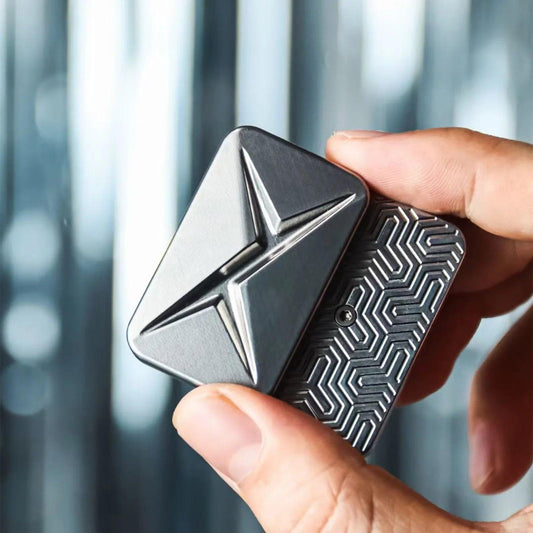
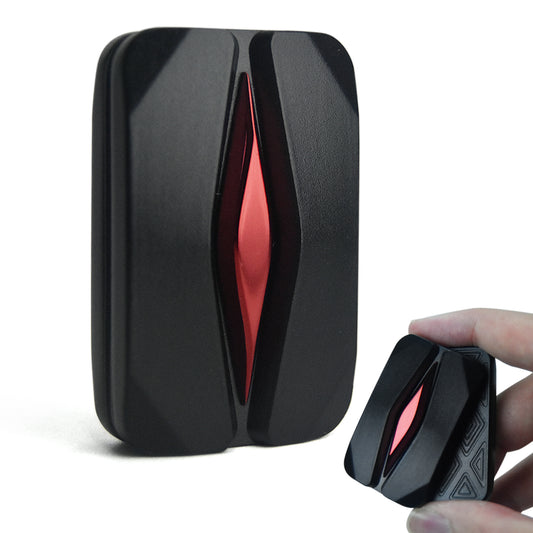
Magnetic sliders with a fixed rail and click stop. Skip these for night shift. The whole point of the format is the audible click when the magnet meets the stop. Even at low force, the click travels. The poker-card magnetic slider at 71 g is a daytime and travel favorite, but it is not a bedroom toy.
Mechanical sliders with a "ding" stop. Worse. The detent produces a pitched bell-like sound that's easier to localize than a click. Save the mechanical "ding" slider for the workshop.
The 60-second bedroom test before you commit
Any new fidget should pass this test before it earns a spot on your nightstand. Sit on the bed with the lights off. Have someone lie down two to three feet away — same distance as your sleeping partner, or your kid in the next bed. Use the fidget normally for sixty seconds. Then stop and listen. If the other person can identify what you were doing without prompting, the toy is too loud for night shift.
What you're listening for: any pitched sound (click, ding, tap), any rhythmic contact (knock, scrape), any bearing whine that pulses. Air whoosh is fine. A one-time soft slide-stop is borderline. Anything that repeats is a problem.
Picking by material and weight
Heavier toys are louder when they contact a surface. A 71 g magnetic slider that you set down on a wood nightstand makes a heavier tap than a 30 g coin. For night shift, lighter is quieter — but only because of contact noise, not the action itself. A 71 g spinner is silent in the air, just as loud as a 30 g spinner if you set it on the nightstand. The discipline is the same: keep the toy in your hand, never set it down mid-use.
Material matters less than people think. Stainless steel, brass, titanium, alloy — in free air, they're all silent. The difference shows up only when two metal parts touch. Avoid two-piece designs with a loose inner piece unless the inner piece is fully captured.
What to actually buy for night shift
If you only own one fidget for late-night use, get a silent spinner or a haptic coin. Both are quiet by design and have no detent. If you want a slider specifically, get a trackless magnetic slider and discipline yourself to slow-stop the inner piece before the magnet catches. If you want a 2-in-1 that covers both modes, the Vortex 2-in-1 fidget gives you silent rotation plus the magnetic clicky slider — but you'll only use the clicky mode during the day.
For shoppers comparing across brands, JUDIXY on Amazon carries metal sliders in the same format range, so you can cross-check weight, dimensions, and silent-vs-clicky claims before you commit. Just verify the spec sheet, because a "silent" listing sometimes means "softer click," not actually silent.
FAQ
Are fidget toys for night shift use safe around sleeping kids?
Keep away from young children. These products contain strong neodymium magnets and small parts that pose a swallowing hazard, and a child grabbing a toy mid-fidget can also wake themselves up.
What's the quietest fidget format?
A well-machined silent spinner or a haptic coin. Both have no detent and produce only the faint sound of skin on metal.
Can a magnetic slider ever be quiet enough for night shift?
Only if you slow the inner piece to a near-stop before the magnet engages. At normal fidget speed, the click is audible across a quiet room.
Do heavier fidgets make more noise?
Only on contact. A heavier toy set down on a hard surface makes a louder tap, but in free motion, weight doesn't add noise.
What should I avoid for night shift?
Any format built around a click, ding, or tap: magnetic click-stop sliders, mechanical "ding" sliders, and any two-piece design with a loose inner piece.