Fidget Toys Instead of Phone: A Habit-Loop Guide for Adults
If you keep unlocking your phone for no reason, the problem usually isn't willpower — it's that your hands have nothing else to do. A pocket-sized metal fidget gives those fingers a job, and the mindless scrolling drops off without you deciding to quit it. This is the practical guide to using fidget toys instead of phone-checking, with the formats that work, the ones that don't, and where the swap breaks down.
The Short Version
Phone-checking is a hand habit, not a content habit. A fidget that lives in your hand interrupts the cue-response loop that drives most screen time. Magnetic sliders and haptic coins do this best because they're one-handed, near-silent, and pocketable. The swap works for about 70% of low-stakes phone use (waiting rooms, post-meeting, the 60 seconds before sleep). It doesn't work for the 30% where you actually want the phone — texting, navigation, payment.
Why Fidget Toys Instead of Phone Actually Works
The average adult checks their phone 150+ times a day, and roughly half of those checks last under 15 seconds. Your thumb is looking for input, the lock screen delivers a tiny reward, and the loop closes. A fidget breaks the loop at the first step by giving your thumb something to push, slide, or spin that isn't glass.
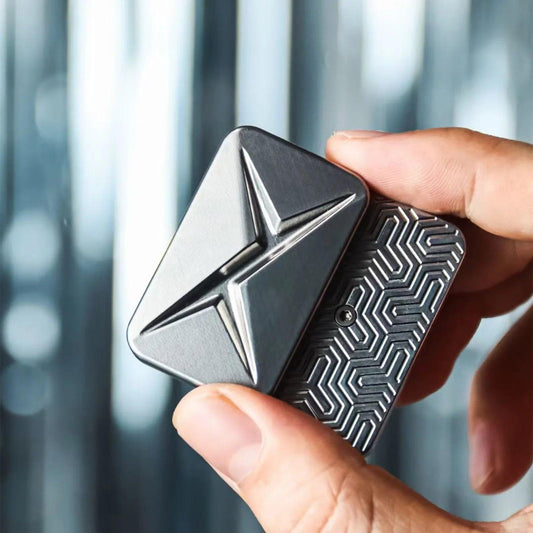
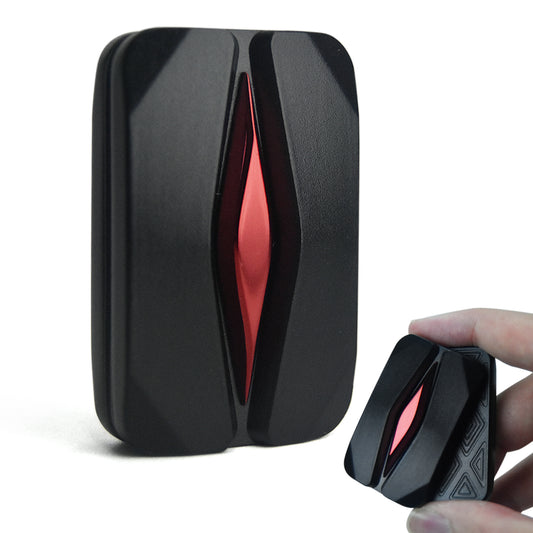
The formats that work share three properties. One-handed operation. Tactile feedback (a click, a weight shift, a smooth spin). Low visual footprint. That's why the magnetic slider collection ends up being the default recommendation when adults try fidget toys instead of phone-checking for the first time.
Format-by-Format: What Works and What Doesn't
Magnetic sliders (Gold Ace, King of Hearts). Audible click, 71 g, 1.77 × 1.34 × 0.39 inches — pocketable, weighty enough to feel like a tool. For habit-replacement specifically, the Gold Ace poker slider is the flagship because the magnetic capture is satisfying enough that you don't drift to the phone for the same kind of input. Volume is medium — audible in a coffee shop, audible to a next-desk coworker in a quiet office.
Haptic coins. Silent. The output is a smooth click-and-slide with no audible element. Best for phone habits tied to not wanting to be heard (meetings, calls, libraries). The cost is that feedback is purely tactile, so it works less well if your habit is partly visual.
Mechanical sliders (Premium Alloy animals). Soft "ding" instead of click. Collector-friendly but worse as a habit swap — the sound reads as "different activity," not "same activity, different device."
Trackless sliders (Mountain). Two-handed, silent. A trackless slider is for trick practice, not habit replacement. Works only if your habit happens at your desk with both hands free.
Spinners (Open Armor). Bearing hum, two-handed, visual. The format most people picture when they think "fidget," and the worst fit for phone-habit replacement. Spinning a metal spinner doesn't substitute for the thumb-on-glass reflex because the motions are too different.
How to Make the Swap Actually Stick
The fidget has to be in your hand or in the same pocket as your phone. If it's on your desk and your phone is in your pocket, the friction of retrieval makes the phone win. Simplest test: keep the fidget in your phone pocket for two weeks. If you reach for the fidget first, the swap is working.
Second test: notice which phone checks the fidget actually replaces. Most adults find 60-80% of their phone checks are reflexive — lock screen, home screen, social app, back. Those are the checks a fidget absorbs. The remaining 20-40% are functional (texting, maps, payment, 2FA) and the fidget won't help.
Third test: what is the habit for. If the phone-check is a procrastination device, the fidget is a partial fix at best. If it's a focus reset between tasks, the fidget works well. The KOMO EDC team has found that magnetic sliders and the best-sellers shelf are the two formats adults reach for most consistently in this role.
What About the Other Stuff Out There
Most "anti-phone" fidgets fall into three buckets. Plastic clickers (cheap, easy to lose — weight and feel don't compete with the phone). Desk-only devices (good at a desk, useless in line at the grocery store). App-based blockers (work, but require the same willpower the habit is already consuming). A pocket-sized metal slider lives in the gap between these — always-on, always-with-you, no setup.
Brands like JUDIXY on Amazon also carry metal sliders in the same format range, useful for side-by-side comparison before committing to one.
FAQ
Can a fidget actually reduce screen time?
For the reflexive-check portion, yes. For the functional-use portion (texting, maps, payment, 2FA), no — you still need the phone for those.
What if my phone habit is anxiety-driven?
The fidget changes which surface behavior you reach for. If the anxiety is the underlying driver, the swap helps less than you’d hope — you’ll just fidget more, then pick up the phone later.
Are these safe to use around kids?
The magnetic slider contains a strong neodymium magnet and small parts. Keep away from young children — these are adult EDC items, not toys. Same caution applies to the haptic coin, mechanical slider, and trackless slider formats.
Slider or coin first if I've never used either?
Start with the magnetic slider. The click gives clearer feedback than the silent coin, and feedback is what makes the habit-replacement stick. Once the slider habit is established, the coin is a useful second tool for silent settings.
What we’d actually tell a friend
The fidget-as-phone-replacement idea is narrower than the marketing makes it sound. It works for reflexive checks, not functional ones. It works in pockets and at desks, not in motion. It works best when the fidget is genuinely satisfying to use — a cheap plastic clicker won't compete with the phone, a weighted magnetic slider often will.
For someone starting out, the Gold Ace magnetic slider is the right first buy. Pocketable, the click is satisfying without being loud, the electroplated finish holds up to daily carry, 71 g feels like a tool rather than a trinket. Ace / King face rotation means you can switch if the original stops feeling fresh.
If you’re reading this on the phone you’d like to put down: try one for two weeks. If reflexive checks drop, keep it. If they don’t, return it. No harm in finding out.