Common Beginner Metal Fidget Mistakes: What Designers Get Wrong About
This guide covers common beginner metal fidget mistakes in plain terms, with no marketing fluff. The biggest beginner metal fidget mistakes have almost nothing to do with the buyer. Most first-time picks fail because the format was designed for people who already know what they want — the unboxing, the weight in the hand, the sound across a quiet office. When a buyer is new, the same features get misread. A heavy slider feels clunky instead of substantial. A loud click feels cheap instead of satisfying. A trackless format feels broken instead of expressive. None of those reactions are the buyer's fault.
Walking through the full EDC fidget starter kit options with that framing in mind changes the conversation. You're not just picking something pretty. You're avoiding a handful of recurring beginner metal fidget mistakes that show up in the lineup no matter which brand you're browsing.
Optimizing for the photo, not the pocket: What an common beginner metal fidget mistakes Actually Means
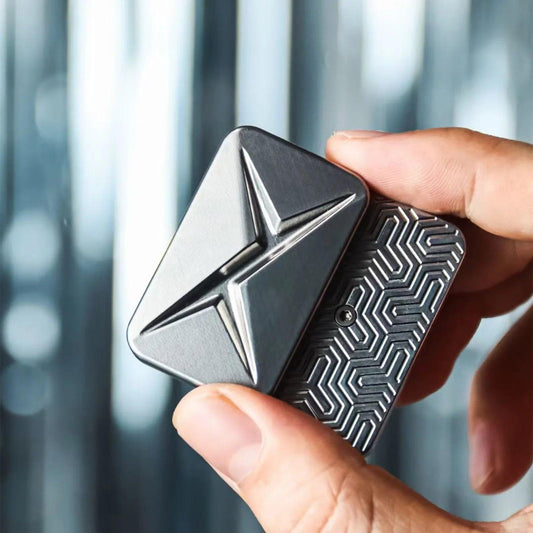
The first beginner metal fidget mistake is buying on looks alone. Catalog photos are shot under directional light, on dark felt, usually at an angle that hides the actual length. A poker-card slider is genuinely compact — 1.77 × 1.34 × 0.39 in — but that fact gets lost between the macro shot and the lifestyle render. Buyers end up imagining something the size of a guitar pick and then receiving a chunk of steel that fills the entire pocket.
It's not a sizing scam. The dimensions are usually correct. The problem is that designers and marketers skip three seconds of context: here is the slider next to a coin, next to a key, next to a phone. Without that comparison, you can't tell whether a piece will ride comfortably next to your wallet or shove it sideways all day.
Whenever possible, look for a scale reference in the photo or specifications. Numbers in inches are useless unless you've handled the format before. A reliable trick is to print a piece of paper to the listed length, cut it out, and slip it into your pocket for ten minutes. If it bothers you, that format is too big.
Weight as a flex instead of a feel
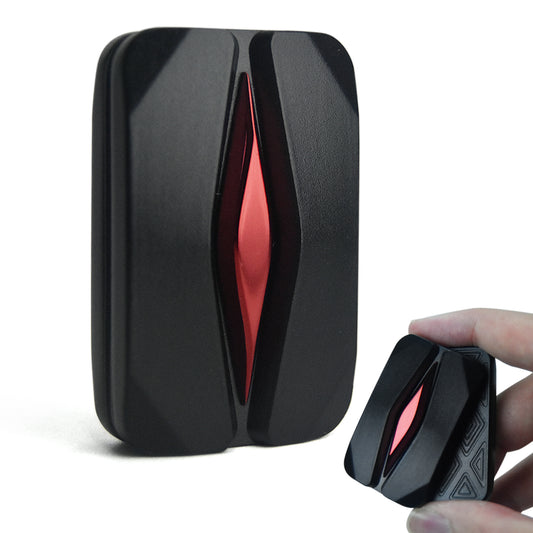
The second of the common beginner metal fidget mistakes is treating weight as a status symbol. Heavier isn't better, especially for a first piece. A 71 g magnetic slider like the Gold Ace or King of Hearts has real substance — you can feel it shift, you can hear the click settle, you can flip it end-over-end without it flying out of your hand. That's the design goal.
The error creeps in when buyers use weight to guess quality. A 120 g brass brick also feels substantial, but it pulls your trouser pocket down, makes your hand tired during a long call, and prints the outline through soft fabric. That's not premium. That's a paperweight pretending to be a fidget toy.
If you want the satisfying heft of a magnetic slider without the gym membership, the Gold Ace (spades, black electroplate) and King of Hearts (hearts, red electroplate) hit a useful middle ground at 71 g. Light enough to forget you're carrying it. Heavy enough to feel like the click has authority.
Sound design that ignores the room
Quiet rooms are where many beginners get burned. The third beginner metal fidget mistake is buying a clicky slider for a bedroom next to a sleeping partner, or assuming a mechanical "ding" slider is office-appropriate because the marketing said so.
Sound scales badly with context. The magnetic click of a poker-card slider is audible at the next desk in a quiet office and easy to mask in a coffee shop. The same click is a problem in a library study room and a non-starter in a shared bedroom. Premium Alloy animal sliders — mechanical, not magnetic — produce a softer "ding," but it's still a ding, and it's still audible up close.
If you're buying for shared spaces, the safer formats are trackless sliders (silent by design), the rotation half of a 2-in-1 like the Vortex, or a haptic coin if you want pure silence. If you're buying for office and travel, the magnetic click is honestly fine. The mistake isn't picking a clicky slider. The mistake is picking one and assuming "quiet enough" instead of testing it in your actual environment.
Format confusion: magnetic, mechanical, trackless
The fourth beginner metal fidget mistake is treating all metal sliders as one product. They're not. Three formats sit on most shelves, and they behave differently:
- Magnetic slider (Gold Ace, King of Hearts) — fixed rail, captured neodymium magnet, audible click at each end of the throw. Best for repetitive, predictable motion.
- Mechanical slider (Premium Alloy animals) — no magnet, a metal detent that produces a soft "ding." Best for collectors and people who prefer a deeper, less sharp sound.
- Trackless slider (Mountain) — no fixed rail, the inner piece floats between magnetic stops. Best for two-handed trick work, not for one-handed fidgeting under a desk.
New buyers often reach for a trackless slider because the trick videos look impressive, then feel frustrated when they can't get the inner piece to behave during a meeting. That's not a skill problem. That's a format mismatch. The Mountain is built for deliberate, two-handed play. If your goal is something to do with one hand while you read, you want the magnetic slider instead.
Single-format tunnel vision
The fifth of the common beginner metal fidget mistakes is buying one piece and assuming the hobby is "done." That almost never works. Different moments call for different formats — a magnetic slider at your desk, a silent trackless at home, a spinner in the back room, a 2-in-1 if you genuinely can't choose. Picking one and treating it as a complete answer usually means a refund or an abandoned drawer piece within a month.
The poker-card magnetic slider lineup is the safest starting point because the format is forgiving — even sloppy one-handed flips produce a clean click. From there, branching into a spinner like Open Armor for visual fidgeting, or a 2-in-1 like Vortex for both rotation and slide in one body, fills in the gaps without doubling your pocket weight.
FAQ
What is the most common beginner metal fidget mistake?
Treating weight and sound as universal quality markers instead of context-dependent feel. A heavy clicky slider is great in an office and terrible in a shared bedroom.
Are metal fidgets good for people who have never owned one before?
Yes — metal formats are more durable than plastic and the sound is more consistent. Start with a magnetic slider in the 60–80 g range so the click has authority without dragging your pocket down.
Should a beginner buy a magnetic slider or a trackless slider first?
Magnetic. Fixed-rail sliders are easier to operate one-handed and produce a predictable sound. Trackless sliders reward two-handed practice and are better as a second piece once you know what kind of motion you actually want.
How loud is a metal fidget toy in an office?
The magnetic click on a poker-card slider carries to the next desk in a quiet room and disappears under coffee-shop noise. Test it in the actual space before you commit.