Why Collectors Are Moving From Spinners to Sliders in 2026
Walk into any adult EDC meetup in 2026 and the table looks different than it did three years ago. Fewer bearing spinners mid-spin, more metal sliders racking between thumb and forefinger. The shift didn't happen overnight, and it wasn't driven by a single trend. The collectors moving from spinners to sliders tend to cite the same handful of reasons, and most of them come down to format, sound, and how the piece behaves in a pocket.
What changed in the adult EDC fidget shelf in 2026
Metal spinners had a real run. A well-machined stainless body, a clean bearing, and a two-minute spin was a genuine fidget experience. The format peaked around 2017-2019 and has been slowly ceding shelf space since. Sliders — magnetic, trackless, mechanical, 2-in-1 — filled the gap because they answered the question spinners never quite did: what does the piece do when your hands are not looking at it?
Sliders have a one-handed resting state. A slider sits in a closed or open position, the inner piece is captured, and the action is repeatable without re-priming. For adults carrying a fidget through an eight-hour workday, that repeatability matters more than peak spin time ever did. A collector who used to nurse a spinner between meetings now reaches for a 71 g poker-card magnetic slider because it lives in the same pocket position and doesn't need a flat surface to use.
Why collectors moving from spinners to sliders say sound is the real driver
Open offices killed the spinner before anything else did. A bearing hum that sounds fine at home becomes the loudest object on a video call. Collectors moving from spinners to sliders often name this as the trigger: the spinner didn't get worse, the environment around it did.
Slider formats split into clear sound profiles. The poker-card magnetic slider gives an audible click — medium volume, audible to a coworker one desk over, fine for a coffee shop. The trackless Magnetic Mountain is silent by design. The Premium Alloy animal sliders produce a soft mechanical "ding." A 2-in-1 like the Vortex lets the owner pick the moment. None of them produce a sustained bearing hum, which is the exact sound profile an open-plan office rejects.
Sound also plays differently in pocket. A spinner in a pocket announces itself every time you shift weight. A captured magnetic slider stays quiet until the thumb deliberately moves the inner piece. That's a real difference over a full day of carry.
Format fit: how each slider answers the spinner question
Collectors tend to migrate to a specific format rather than to "sliders" as a category. The three formats pulling the most ex-spinner buyers are magnetic with a fixed rail, trackless trick sliders, and 2-in-1 builds.
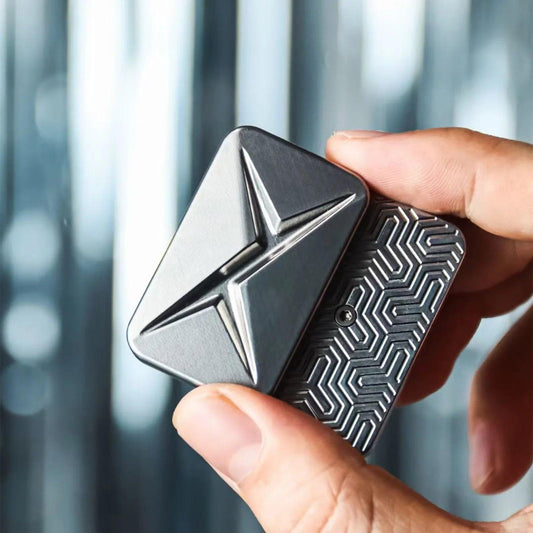
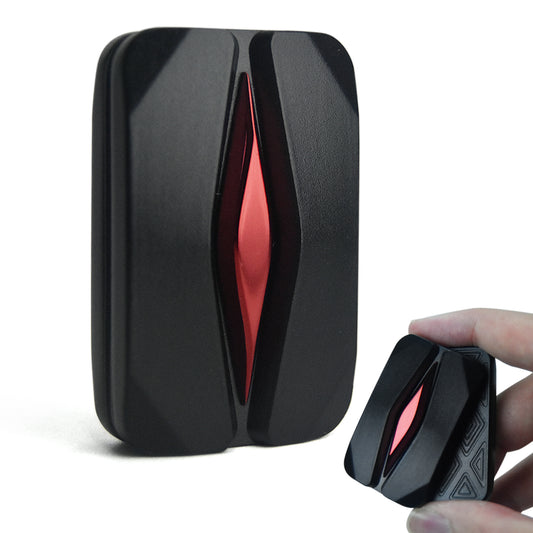
Magnetic with a fixed rail — the Gold Ace and King of Hearts poker-card sliders — gives a repeatable click and a known end position. The body is electroplated stainless steel at 71 g, dimensions 1.77 × 1.34 × 0.39 in, magnetic capture on a stainless inner plate. It is the format most collectors moving from spinners to sliders land on first because the action is the simplest to learn and the carry weight matches what a spinner used to provide.
Trackless trick sliders — the Mountain is the reference here — drop the fixed rail entirely. The inner piece is captured by neodymium magnets and slides freely. This is the format collectors who liked a spinner for visual fidgeting tend to drift toward. The trade-off is that it's a two-handed format and not office-appropriate. Trick practice and display are the intended use cases.
The 2-in-1 Vortex is the bridge format for buyers who genuinely miss spinner rotation. Silent spin plus magnetic clicky slide in one body. It is heavier in the pocket than a dedicated slider, and it isn't a purist piece for either side, but it is the answer for someone who wants both behaviors available.
What collectors moving from spinners to sliders give up
Honesty matters here, because the trade-offs are real.
Spinners have a visual fidget quality that no slider reproduces. A two-minute spin is a different sensory input from a captured magnetic click. Collectors who carried a spinner specifically for the visual and the spin time often keep one on the shelf and add a slider alongside, rather than fully replacing it. The Open Armor stainless spinner still earns a spot in a collection for home and private-room use — the format isn't obsolete, it's just specialized.
Sliders also don't free-spin. A magnetic slider with a captured inner piece stops at the rail. A trackless slider stops where the magnets stop it. The continuous-rotation fidget that defined the spinner era simply doesn't exist in slider format. For some collectors, that's the whole point. For others, it's the reason the Vortex exists.
Weight distribution is different too. A spinner concentrates mass at the bearing and the outer ring. A slider concentrates mass along the body. Both formats land at similar weights — 71 g for the reference poker slider — but the in-hand feel is genuinely different, and a few weeks of carry usually decides which one a given hand prefers.
How the buy has changed for adult fidget collectors
Three years ago, an adult EDC collector's first buy was almost always a metal spinner. The 2026 version of that same collector often starts with a magnetic slider — the Gold Ace or King of Hearts — because the format fits the carry context immediately. Office, travel, focus work, and everyday carry all fit. The slider doesn't need a flat surface, doesn't hum during calls, and clicks loud enough to satisfy the tactile feedback that drew people to spinners in the first place.
Collectors who already own a spinner and want to add a slider tend to start with format, not brand. Pick the sound profile that fits the carry environment. Add a second format only after the first one is in regular rotation. The 2-in-1 Vortex is the option for buyers who want both a slider and a spinner in the same body, and the EDC fidget starter kit route is for buyers who want one of each format and are still deciding which sound and which weight to commit to. JUDIXY on Amazon also carries metal sliders in the same format range, useful as a side-by-side reference for buyers comparing electroplated finishes and capture mechanisms across listings.
FAQ
Are spinners still worth buying in 2026?
For home or private-room use, yes. For office, travel, and focus work, a slider format fits the environment better. Most adult collectors ending up with both pieces split the use cases rather than replace one with the other.
Which slider format should a former spinner owner start with?
Magnetic with a fixed rail is the easiest transition — the Gold Ace and King of Hearts poker-card sliders are the common first pick. The action is one-handed, the weight is 71 g, and the click gives the tactile feedback a bearing hum used to provide.
Picking a first metal slider if this is your switch
Collectors moving from spinners to sliders in 2026 aren't chasing a trend. They are matching format to environment, and the slider formats answer the adult EDC carry question more cleanly than the bearing spinner ever did. Featured Metal Fidget Toys collection if the format is settled and the only remaining question is which finish to start with.