Are Metal Fidget Toys Safe for Kids? An Adult Buyer's Guide
If you're shopping for yourself and wondering are metal fidget toys safe for kids to leave around the house, the short answer is no. The same features that make a metal slider satisfying for an adult — strong neodymium magnets, tight tolerances, compact size — are exactly what make these objects dangerous in the hands of a toddler. This guide is written for the adult buyer, not the child user. If a kid in your household has been eyeing your gear, here's what the safety profile actually looks like and which adult fidget formats carry the least risk when supervised.
The core safety problem: magnets and small parts: What an are metal fidget toys safe for kids Actually Means
Most metal EDC fidgets fall into two risk categories. The first is magnetic. Poker-card sliders, trackless trick sliders, and 2-in-1 designs like the Vortex all rely on neodymium magnets to create the satisfying click or capture. Neodymium magnets are extraordinarily strong for their size — strong enough that if a child swallows two of them and they attract across intestinal tissue, the result is a surgical emergency. The second category is small parts. Premium Alloy animal sliders, mechanical clickers, and many spinners have internal pieces that can work loose with rough handling. Neither category is appropriate for unsupervised child play.
Keep away from young children. That phrase belongs on every adult-metal-EDC product page for a reason: ingestion of small high-strength magnets has caused permanent injury and death in pediatric cases documented by the CPSC. If you carry a metal fidget in a pocket or on a desk, store it in a drawer or a closed case the moment a child enters the room.
What "adult EDC fidget" actually means
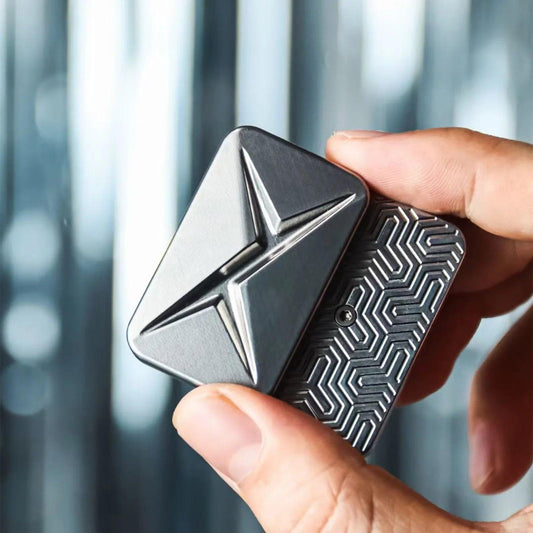
EDC stands for everyday carry. The category is built around pocketable objects designed for adult hands and adult use contexts: open offices, video calls, focus work, travel, and downtime at home. Materials lean toward stainless steel, brass, titanium, and proprietary alloys. Mechanisms lean toward magnetic detents, mechanical detents, captured bearings, and weighted spinners. None of that is engineered for a child. The weights alone tell the story — the poker-card slider comes in at 71 g in a 1.77 × 1.34 × 0.39 in body, roughly the size of a credit card but twice as heavy. That's a satisfying object for a grown hand and a hard object for a small one to drop on a foot.
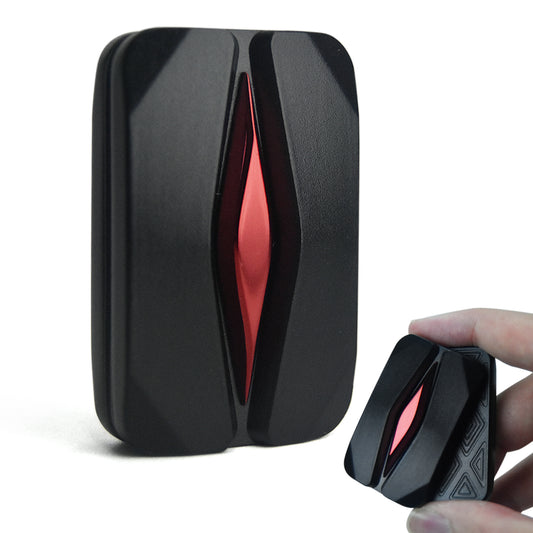
The format names — magnetic slider, trackless slider, 2-in-1, mechanical clicker — describe mechanisms that assume adult motor control and adult judgment about when a click is appropriate. A trackless trick slider, for example, requires two-handed play and produces visible motion. That's a poor fit for a video call and a worse fit for a child who hasn't learned to read the room.
Format-by-format risk profile
Not every adult fidget carries the same hazard level. Here's how the formats stack up when a curious kid is in the picture.
Magnetic sliders (Gold Ace, King of Hearts). Highest concern. Captured neodymium magnet plus audible click mechanism. The magnet is engineered not to fall out under normal use, but "normal use" assumes an adult user. If the body gets pried open or the slider is dropped hard enough to deform the case, the internal plate can become accessible.
Trackless sliders (Mountain). Similar concern. The captured inner piece slides freely on magnet force alone, which means there is no track to constrain it. Visual fidgeting is the point. A child who pries it open can access the magnet.
Mechanical sliders (Premium Alloy animals). Lower magnetic risk because the mechanism is a metal detent rather than a neodymium magnet, but the internal pieces can still come loose under hard impact. The "ding" sound that adults find satisfying is exactly the kind of noise that draws a toddler's attention.
Spinners (Open Armor). Bearing-based, no magnets. The bearing itself is a small part if the spinner is disassembled, and the spin motion is visually engaging enough that a child will want to grab it.
2-in-1 (Vortex). Combines magnetic and rotational elements. Same dual hazard as the formats above.
Haptic coins. Lowest hazard among metal fidgets, but check the specific construction. Some haptic coins use shielded magnets; others rely purely on weight and texture.
How adult buyers should think about storage and supervision
If you live with children or have kids visiting, the question are metal fidget toys safe for kids really becomes a question about your storage habits. Three rules cover most cases.
First, treat the fidget like a knife or a firearm: stored, not displayed. A desk where a toddler can reach is not a storage location. A drawer with a latch, a closed EDC pouch on a high shelf, or a locked cabinet is.
Second, never let a child handle the fidget unsupervised, even briefly. "He was just looking at it" is how most ingestion incidents start. The CPSC cases that prompted the magnet safety campaign almost always involved a moment of inattention.
Third, if a slider or spinner shows visible damage — a deformed case, a loose end cap, a bearing that no longer spins smoothly — retire it. Damaged units are more likely to release internal parts under handling.
None of this requires you to stop using the fidget yourself. It requires you to treat it as an adult tool with an off-switch and a storage plan.
If you want to compare formats in one place, the are metal fidget toys safe for kids collection has every metal body we make, and the Featured Metal Fidget Toys collection shows what other adults actually carry.
FAQ
Are metal fidget toys safe for kids under any age?
No. Manufacturers do not rate these objects for child use. The magnet strength and small-parts profile rule out safe handling for any age group that lacks the judgment to keep the object out of their mouth and the motor control to avoid disassembly.
What age is appropriate for an adult metal fidget?
The category is designed for adult users. Teens with mature motor control can use them under the same supervision rules as any sharp or heavy object. Younger children should not have access.
Are there kid-safe alternatives to adult metal fidgets?
Yes. Plastic fidget toys certified for the relevant age group are widely available and use weaker magnets or non-magnetic mechanisms. They lack the weight and sound of metal, which is the whole point for an adult buyer — but for a child, that's a feature, not a bug.
Do adult fidget toys come with child-safety warnings?
Reputable sellers include the "keep away from young children" line on product listings and packaging. The warning is a legal and ethical requirement, not a suggestion.
Choosing an adult fidget when kids are in the house
If the question are metal fidget toys safe for kids is on your mind, you're already thinking about it correctly. The adult format itself isn't the issue — the storage and supervision around it is. Browse the poker-card magnetic slider lineup for the format most adult buyers start with, then commit to a storage routine that puts the object out of reach between uses. A heavy stainless slider at 71 g in a credit-card footprint is a genuinely good adult fidget. It is not, and was never meant to be, a toy for a child. Pick the format that fits your use case, store it like the adult tool it is, and the question answers itself.