How to Spot a Fake Metal Fidget Toy Before You Buy
A fake metal fidget toy rarely announces itself. The listing shows a slick chunk of CNC-machined metal on a black background, the price is lower than everyone in the comments section, and the seller ships fast. Three weeks later you have a zinc alloy pendant that weighs less than a pack of gum and smells like a hardware store. This guide is the checklist I run through before I buy anything shaped like a metal slider, spinner, or trackless piece online. None of these tests require special tools — just your hands, a fridge magnet, and a quiet room.
Why the fake metal fidget toy problem is getting worse
The category has matured fast. Five years ago a "metal fidget" was almost always a spinner, and most of them were legitimately machined. Now metal sliders, magnetic clickers, and trackless pieces are everywhere — and so are the look-alikes. Drop-shippers can source a sand-cast zinc shell with a printed logo for a fraction of the cost of an electroplated steel body. They list it with stolen photos, undercut the real brand by 30 to 50 percent, and move on before the negative reviews pile up.
The reason this matters: the magnet inside a real metal slider is what makes it feel right. A fake metal fidget toy will often have a weak or absent magnet, which means the click is mushy, the slide floats, and the satisfying snap you paid for never arrives. Cheap zinc also corrodes fast against skin oils, so a "metal" piece that goes green at the corners in a month is a dead giveaway.
Six checks that catch most fakes
Run through these in order. If a listing fails two or more, walk away.
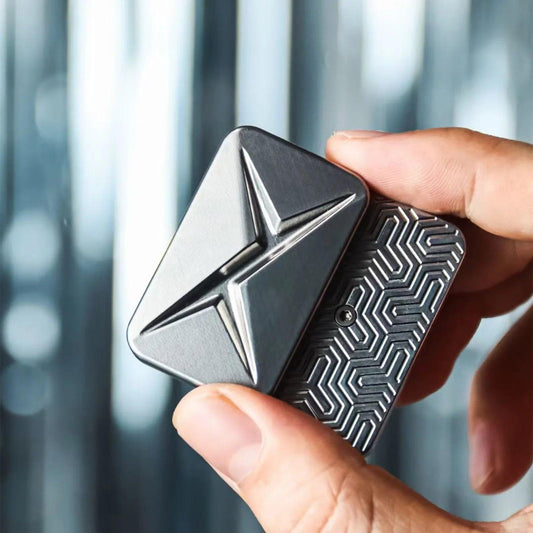
1. The weight test. A genuine compact metal slider is dense. Our poker-card style sliders come in at 71 g for a body roughly 1.77 by 1.34 by 0.39 inches. Pick up the listing photo next to a coin of known weight — if the seller claims "solid metal" but the listed weight is under 30 g for that size, something is off. Zinc castings and plated plastic both feel light in the hand, and the listing will quietly omit weight entirely if it would expose the issue.
2. The fridge magnet test. Real steel and most iron-bearing alloys stick to a magnet. Aluminum and titanium do not. If the listing says "stainless steel" or "premium alloy" but a kitchen magnet slides off, the body is aluminum painted to look like steel, or it's a non-ferrous alloy the seller didn't disclose. Neither is automatically a scam, but the listing is being dishonest about material, and that is reason enough to be cautious.
3. The sound test. Magnetic sliders make a distinct, sharp click when the inner plate hits the stop. Tap the listing description for any audio or video sample. If there is no sample and the seller won't send one on request, that's a yellow flag. Fakes often have a softer, duller click because the magnet is undersized or misaligned. The opposite problem — total silence on a "clicky" listing — usually means the magnet was omitted entirely.
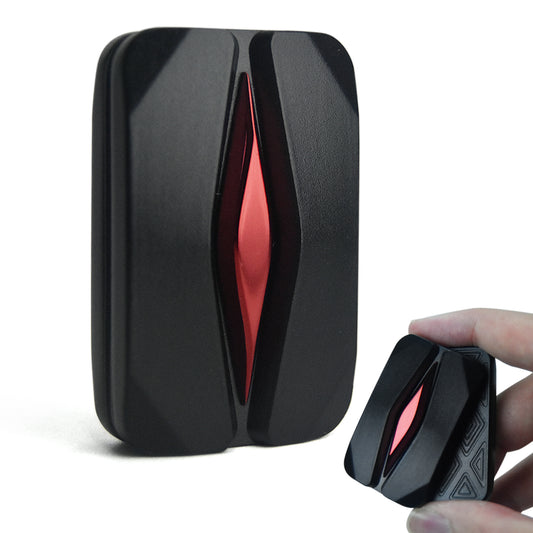
4. The finish test. Look at the edges and the inside of any opening. Real electroplating covers the part evenly, including the inner rim where the slider plate travels. A fake metal fidget toy often has a clean exterior and a raw, uncoated interior — the giveaway is a color seam where the plating stops. Black electroplate on a real steel body should look black inside the slot too, not silver.
5. The tolerance test. Compare the listing photo to known reference photos from the brand. Real CNC parts have crisp, parallel edges. Cast fakes have soft corners, slightly rounded lettering, and visible mold lines along the sides. A 5x crop of the logo is usually enough to tell — sloppy serif edges on the engraving are a strong tell.
6. The seller test. Search the seller name plus "fake" or "scam" before you check out. New storefronts with thousands of listings and no company address are riskier than small shops with a clear return policy. If the only contact method is a generic Gmail address with no business registration anywhere on the page, treat the listing as suspect regardless of how good the photos look.
Where real metal sliders actually ship from
Once you know what to look for, the buying decision gets simpler. A genuine metal fidget lives at the intersection of three signals: a verifiable weight in the listing, a real magnetic mechanism you can hear in a sample video, and a seller with a traceable business. Browse a curated magnetic poker-card slider collection and you can compare weights, sounds, and finishes across the format side by side rather than guessing from a single listing.
If you also want a fidget that does more than one thing, the same checks apply to multifunctional pieces. A real 2-in-1 will have a working silent rotation and a working magnetic slide — not just one mode with the other glued in place. Our 2-in-1 fidget format page shows what both mechanisms actually look like when they are engineered together instead of bolted on.
FAQ
What is the fastest single test for a fake metal fidget toy?
The weight test. Pick the item up — or compare the listed weight to a known genuine piece of the same size. If it feels hollow or the seller refuses to list a weight, you usually have your answer in five seconds.
Are all aluminum fakes?
No. Aluminum is a legitimate material for fidget toys, and a well-machined aluminum slider can feel great in the hand. The problem is not the metal — it is the seller describing aluminum as "stainless steel" or "premium alloy" to justify a higher price. Honest material labeling is the signal to watch for.
Can I trust a listing that has lots of photos?
Photos are the easiest thing to fake. Real protection comes from a verifiable business address, a written return policy, and ideally a short video of the piece in motion. Many photos online are lifted from the original brand's site and re-uploaded — reverse image search catches this more often than people expect.
Does a weak magnet always mean a fake?
Not always. Some real pieces use smaller neodymium magnets for a softer feel. But a magnetic slider with no audible click at all, or a click that feels mushy when you slide the plate, is a problem. The magnet is what defines the format — if it isn't doing its job, the piece isn't doing what you bought it for.
Picking your first real metal fidget
If this is your first piece and you want the format with the most honest signal-to-noise ratio, start with a magnetic poker-card slider. The weight is consistent across the format (around 71 g for the compact body), the click is easy to evaluate from a video, and the electroplated finish is straightforward to inspect in person when it arrives. Browse the full metal fidget collection to see the format range, then narrow down by sound profile and weight. The piece you actually want is the one where the listing answers all six questions above without you having to ask.