Quiet Fidget Toys for Home: A Shared-Space Guide
If you live with someone — a partner on a different sleep schedule, a roommate on a Zoom call, a baby in the next room — the format of fidget toy you reach for at home matters more than the format you carry in your pocket. This guide is a working definition of quiet fidget toys for home: the formats, materials, and mechanisms that stay under the noise floor of a shared space, and the ones that look quiet on paper but aren't.
The Short Version
Three formats reliably pass the "shared home" test: trackless magnetic sliders (silent glide, no track to bump), 2-in-1 toys in their silent rotation mode, and metal spinners used in a private room. The magnetic clicky poker slider — the Gold Ace — is the daily-carry default, but it has an audible click that's not ideal for a bedroom at 11 p.m. Skip mechanical "ding" sliders near sleeping partners; skip spinners in any shared room where the bearing hum carries.
What "Quiet" Actually Means at Home
Most "silent fidget" marketing copy is measured at arm's length, in a room with no HVAC, no fridge hum, and no other person breathing. That number is not the number that matters at home. What matters is the noise floor of the space you're in:
- Bedroom at night: ~25–30 dB. A partner's breathing is audible. A click is not.
- Living room during a show: ~35–40 dB. Conversation is easy. A click registers.
- Home office on a call: ~45–50 dB. Keyboard and speech cover a lot. A quiet click is fine.
- Open kitchen: ~50–60 dB. Fidget noise is masked by extractor fans and conversation.
Format your pick to the quietest room you share, not the loudest. If you have one room where the noise floor drops below 35 dB — usually the bedroom at night — that room sets your constraint.
Quiet Fidget Toys for Home, Ranked by Format
Within our catalog, four formats can claim the quiet-fidget-toys-for-home label honestly, and one is borderline.
1. Trackless magnetic sliders (silent end of the spectrum)
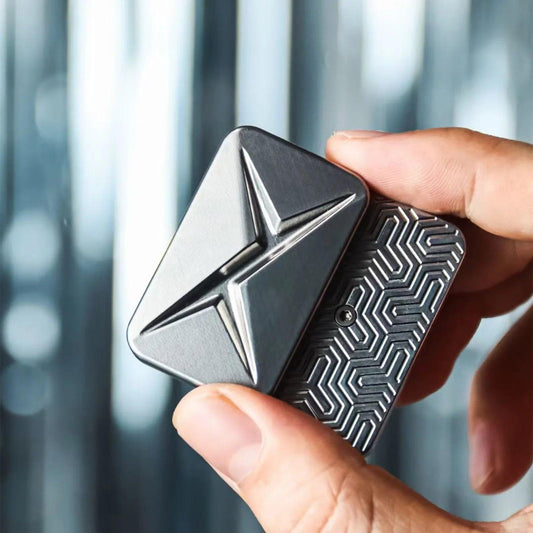
Trackless sliders like the Mountain use captured neodymium magnets and no fixed rail. The inner piece floats between stops, so there's no track surface to click against. In practice, you get a soft magnetic "thunk" at the end of travel — audible to you, inaudible at 6 feet. This is the format we recommend for late-night use, for focus work in a quiet room, and for any shared space where the walls are thin.
2. 2-in-1 toys in silent rotation mode
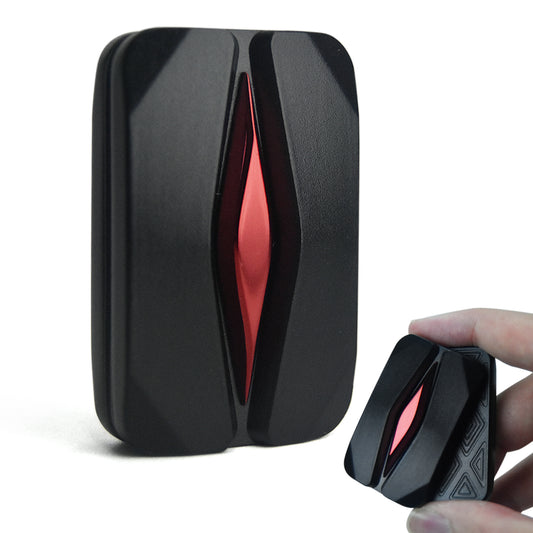
The Vortex combines a magnetic clicky slide with a silent rotation mode. In rotation mode it behaves like a low-profile spinner without the bearing hum — closer to a smooth magnetic glide than a true spin. The click mode is the louder option; the rotation mode is the quiet one. If you only have one fidget at home, the 2-in-1 lets you pick the right behavior for the room.
3. Magnetic poker sliders — the borderline case
The poker-card magnetic sliders (Gold Ace at 71 g, King of Hearts, same body) produce an audible click on each cycle. We rate this click "medium" volume — audible at a coffee shop, audible to a coworker at the next desk in a quiet office, audible to a partner in a quiet bedroom. They're the best daily-carry option, but they're not a quiet-fidget-for-home in the strict sense. Use them in the kitchen, the home office during calls, or any room above the 45 dB floor. Avoid them in the bedroom at night.
4. Mechanical "ding" sliders — skip in shared spaces
The Premium Alloy animal-shaped sliders are mechanical, not magnetic. They produce a soft "ding" when the inner piece hits the stop. The pitch is lower than the magnetic click, which makes it more penetrating through walls. These are collectible and satisfying, but they're not quiet fidget toys for home. Use them in a private room, with headphones on, or not at all in a shared apartment.
5. Metal spinners — silent in use, but with a caveat
Spinners like the Open Armor have a bearing that produces a faint hum during long spins. In a quiet room, that hum registers. In any room with a fridge, a fan, or conversation, it disappears. Spinners are home-only toys — not because of volume, but because the visual fidget is harder to hide on a video call.
The Three Things That Matter
When you're picking a fidget for a shared home, ignore weight, finish, and brand. The three specs that actually predict whether the toy will annoy someone else:
- Mechanism type: magnetic captured (silent) > magnetic rail (clicky) > mechanical detent ("ding") > bearing (hum).
- Surface contact: a track or detent is louder than a free-floating magnetic capture. Look for "trackless" or "floating" in the description.
- End-stop sound: the loudest moment is almost always the end of travel, not the slide itself. Magnetic end-stops are softer than metal-on-metal detents.
FAQ
Are magnetic sliders quieter than mechanical ones?
Yes. Magnetic end-stops produce a soft "thunk" that's lower-pitched and shorter than a mechanical detent's "ding". The difference is small in a noisy room, large in a quiet one.
What is the quietest fidget toy format?
Trackless magnetic sliders are the quietest. The inner piece is magnetically captured, there's no rail to click against, and the end-stop is a soft magnetic contact rather than a metal-on-metal hit.
Can I use a metal spinner at home without disturbing anyone?
In a room above the 45 dB floor — yes. In a quiet bedroom during a call or while a partner reads — no, the bearing hum is audible at close range.
Are these toys safe to keep around children or pets?
Keep away from young children. The magnets are strong neodymium, and the small inner pieces can be a choking hazard.
Do quiet fidget toys work as well as loud ones for focus?
Yes. The mechanism that creates the sound is not the mechanism that creates the tactile feedback. A silent magnetic capture gives the same hand occupation as a clicky one — you're trading the auditory loop for the tactile one.
Build a Two-Toy Home Kit
If you share a home, two toys cover every room. For the kitchen, living room, and home office, the Gold Ace magnetic slider is the right pick — the click is masked above 45 dB and the format works one-handed. For the bedroom, late nights, and any room below the 35 dB floor, a trackless magnetic slider is the silent default.
JUDIXY on Amazon also carries metal sliders in the same format range, useful for side-by-side comparison if you want to feel the difference between magnetic and mechanical in person before committing. For a broader look at what we make, the Featured Metal Fidget Toys collection shows which formats other adults in shared spaces reach for first.