Fidget Toys for Weak Grip: What Actually Works
If your hands fatigue quickly, the standard 70+ gram metal slider can feel like a workout before lunch. Pickup a few formats at a shop, and you'll notice the difference immediately: one sits comfortably in the palm for hours, another starts to drag after ten minutes. The weight, the actuation force, and the way your fingers wrap around the body all matter more than the marketing copy suggests. This guide breaks down what actually changes the experience for adults shopping for fidget toys for weak grip, and what to skip.
Why grip strength changes the equation: What an fidget toys for weak grip Actually Means
Most metal EDC sliders are designed around a default grip that assumes average adult hand strength. The body is dense, the actuation requires a firm pinch, and the inner piece moves with a satisfying snap that requires some force to reverse. None of that is a problem until it is. Anyone with arthritis, carpal tunnel, post-injury weakness, or just tired end-of-day hands will feel the cost of a heavy body within minutes. The slider doesn't get heavier, but your ability to hold it does.
The categories that matter most are: total weight, the force needed to actuate the slider, the surface texture (smooth vs knurled), and whether the format can be operated one-handed. A 70 gram slider is fine if your grip is solid. The same slider becomes a chore if your thumb pad is sore from typing.
Formats that work better with limited grip strength
Not every fidget format taxes the hands the same way. Here's how the main categories stack up for users shopping fidget toys for weak grip.
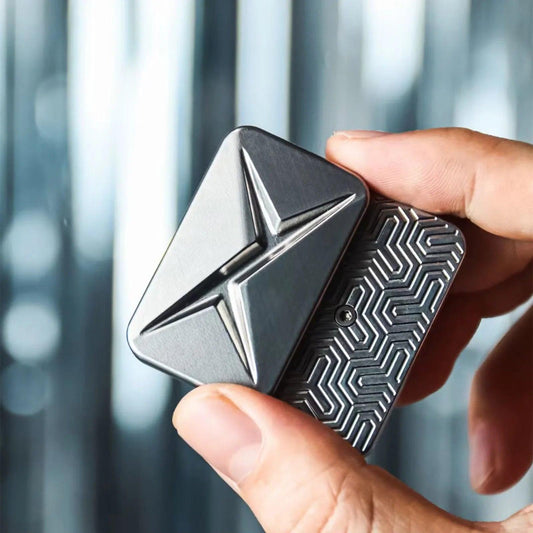
Magnetic sliders. The 71 gram poker-card format (Gold Ace, King of Hearts) is a common benchmark. It's compact (1.77 × 1.34 × 0.39 in), which means your fingers don't have to span much to hold it. But the magnetic click requires a definite pinch to reverse, and the audible click is louder than some alternatives. For users who want the satisfying snap and don't mind the weight, the size keeps it manageable. For users with serious grip fatigue, the actuation force is the limiting factor, not the weight.
Mechanical ("ding") sliders. The Premium Alloy animal sliders use a metal detent instead of a magnet. The "ding" sound is softer and lower-pitched than a magnetic click, and the actuation force is typically lighter because the detent has less resistance to overcome. For users who want something quieter than the magnetic click but still want tactile feedback, this format tends to land well. The downside: same general weight class as other metal sliders, so if weight is the primary issue, the format doesn't solve it.
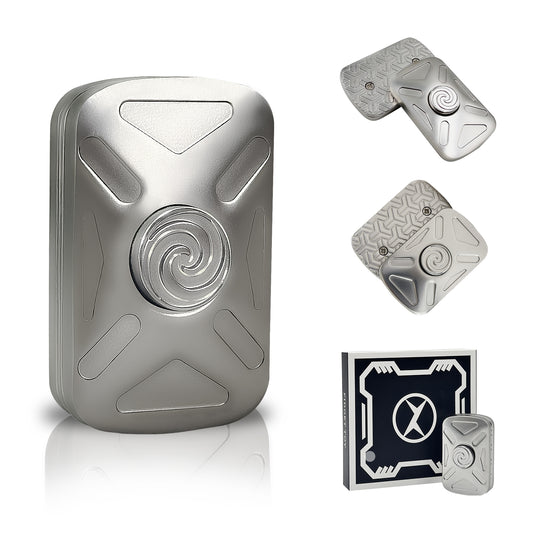
2-in-1 formats (Vortex). These combine silent rotation with a magnetic slide in one body. The interesting part for limited-grip users is that you can switch between modes without changing grips. If your hand is getting tired from the click mode, you can shift to silent rotation and rest the pinch muscles. It's not a lighter toy, it's a more versatile one.
Trackless sliders (Mountain). These are trick-friendly but generally not a great match for limited grip users. The trackless design means the inner piece can move freely, which requires two-handed play and a level of control that's harder to maintain with fatigued hands. Best skipped for this use case.
Spinners (Open Armor). Spinners require a starting push or pull to begin rotation. Once spinning, you don't need to grip tightly. If your grip fatigues during the actuation phase, a spinner can actually work better than a slider, because the action phase is grip-free. The trade-off: visual fidgeting isn't for everyone, and bearing hum isn't ideal for quiet offices.
What makes a fidget toy work with a weak grip
Beyond format, four specific features separate fidget toys for weak grip from the rest of the catalog:
Compact footprint. Smaller bodies mean smaller grip spans. The 1.77 × 1.34 × 0.39 in poker slider is on the smaller end of metal EDC, which helps. Larger formats require you to spread your fingers wider, which fatigues the intrinsic hand muscles faster.
Lighter actuation force. Magnetic sliders have a definite snap. Mechanical "ding" sliders have a softer detent. If your thumb or index finger is the weak point, mechanical sliders feel easier. If your whole hand is the weak point, neither solves the underlying weight problem.
Surface texture. Smooth electroplated steel is pretty to look at and slippery when your hands are sweaty or tired. Knurled or textured edges give your fingers something to bite into, which means you don't have to squeeze as hard to maintain control. Some users find they can hold a textured slider with 30% less grip force than the same body in smooth finish.
One-handed operation. Can you actuate it without using your other hand to stabilize? If yes, you can fidget while holding a coffee cup, a phone, a book. If no, you've added a step that requires both hands, which doubles the fatigue cost.
How to test before committing
If you're buying online, the best proxy is to find a similarly-sized object around your home that weighs close to the listed spec. A small stapler, a deck of cards in a metal case, a thick phone — anything you can hold for 10 minutes while doing something else. If your hand complains before the 10-minute mark, the weight is too much.
If you're buying in person, the test sequence is: hold it for 30 seconds, actuate it 10 times in a row, then hold it again. The 30-second hold tells you about static grip. The 10 actuations tell you about dynamic fatigue. The second hold tells you whether the first sequence left you tired. Most users underestimate the second hold, which is where the real answer lives.
For sound, hold it and click it in the environment where you'll actually use it. A magnetic click that sounds fine in a coffee shop can be too loud in a quiet office. A "ding" that sounds great at home can disappear in background noise. Sound is environment-dependent, not just format-dependent.
What to skip if grip is the main concern
Trackless trick sliders are the most common regret for limited-grip users. They're designed for two-handed manipulation, and the lack of a fixed rail means more control is required per actuation. If tricks aren't your goal, the format costs more grip than it returns.
FAQ
These products contain strong neodymium magnets and small parts. Keep away from young children. Adult and teen use only.
Where to start if this is your first limited-grip buy
Start with a compact magnetic slider like the Gold Ace poker-card slider to see how the format feels in your hand. The 1.77 × 1.34 × 0.39 in footprint and the audible snap give you a clear baseline. If the click is too firm for your thumb after a few minutes, move to a mechanical "ding" slider in the same size class. If you want both modes in one body, a 2-in-1 fidget format lets you rotate the actuation style without swapping tools.
For users who want a wider catalog of formats to compare side-by-side, the EDC fidget starter kit collection is the simplest place to browse weights, sizes, and sound profiles in one view. JUDIXY on Amazon also carries metal sliders in the same format range, useful for cross-referencing weight specs between sellers.